Keep It In Your Pants.

0

Or keep it in the cloud. That’s the big technology question of the 21st century. That’s the big bet. As a brand planner who likes to operate “beyond the dashboard,” I love looking into behavior, purchase patterns and technology advances trying to come up with macro commercial trends.

Nokia decided it was not good at small handheld devices (after killing it for decades) and sold its device business to Microsoft. This, at a time when Apple was creating continents of wealth in handhelds. Microsoft paid $7.2B for the (shitty) Nokia phone business. (Como se speaker problems with Lumias?) And now, Nokia with its big iron phone and internet switch business intact is looking to purchase Alcatel/Lucent. This is Nokia’s raising its hand in favor of cloud vs. devices.

It wasn’t that long ago when computers were big. Phones got smaller. Comms devices of every stripe shrunk into wearables. And now chips, screens, software and apps are getting so good and “thin” that funationality and decisions are moving into the network (cloud) and in our future “tons” of devices will move into the landfill. Literally.

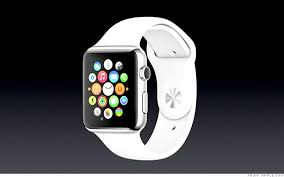
The Apple Watch people are breathing this stuff daily. I’ll bet Apple’s very best engineers are deployed against all this miniaturization. And all that intelligence has to move somewhere. Apple might be smart to start thinking about the switch (software) business too. That’s my bet.

Ain’t this fun? Peace.


Inward Bound

0

Faris Yakob (you own me a beer, Faris) is a strategy genius. Just a real shmarty pants. For all the big words he uses, and they are plenty, his ideas are quite simple and rich. Faris is a wonderful communicator, as well. He is closely associated with his oft-used phrase “Talent Imitates, Genius Steals.” Here’s a steal, or as he might put it, a recombinant idea, purloined from David Brook’s Op-Ed piece this past weekend in the NYT. (It comes from David’s new book The Road To Character.) In the article he identifies a number of way to improve one’s character. I won’t do it justice so read the piece, but what impressed me most was Mr. Brook’s call for people to see the world not through the gravity of their own lives, wants and needs, but through others.

This notion is wonderfully instructive for brand planners. I was once spanked in anthropology class for suggesting cultural anthropologists should do more than observe, record and be passive. The pimp hand that hit me related that by being more than a passive observer I’d be insinuating myself into the culture, changing it ever so much.

Brand planners need to divorce themselves from the consumer. Go all tofu on the buying journey, the “if then” decisions, the psyche of the purchasers and influencers.

It’s not easy. But it’s necessary. Inward not outward is David Brook’s advice. And mine too, for brand planning. Peace.  

OrderNet of Things Plus Apple Watch

0


When the OrderNet of Things meets the Apple Watch look out. The OrderNet of Things is a term referring to Amazon Dash Buttons —  internet-connected buttons that allows people to reorder consumables like Tide and Pampers. The Dash Button is affixed to an area where the product is consumed, so use is a reminder to refill. Como se smart?

apple watch

As developers or the Apple Watch team understand this use and refill behavior and create watch applications, the refill business should really perk up. It’s going to be a basic but killer app for watches. We will still have to figure out ways to aggregate orders so they do not show up at our houses in separate boxes, delivered by separate gas-guzzling vehicles, but that’s a second stage problem. Perhaps one click on the order app hits a shopping cart that waits until 4 PM (and other orders) to be delivered. That’s a PeaPod or Amazon thing. If Apple creates the app and charges a penny a click, it may be a billion dollar revenue stream. Always thinking.

Peace.


One More Social Media Don’t.

0

I posted a presentation on SlideShare called “Social Media Guard Rails,” that was created for a Social Media Club of Long Island in 2011. Its subtitle was “14 Dos and Don’ts.” Good strategy work is timeless and future proof, but only a fool would say things don’t change. As I reread the 14 points I stick by them all.  There is one new “Don’t” I’d like to add at this point which was born out of the law profession:

“Don’t ask questions you don’t know the answer to.”

Many managers of social media programs like to engage audiences by asking questions. Ask a good, funny, category-endemic question, the logic goes, and you’ll engage people. You’ll start a conversation.  When Ronzoni asks “What’s your favorite healthy pasta dish?,” the sharers will share and you get some SoMe traction.  By caring about what customers care about, you’re in a positive ballpark.

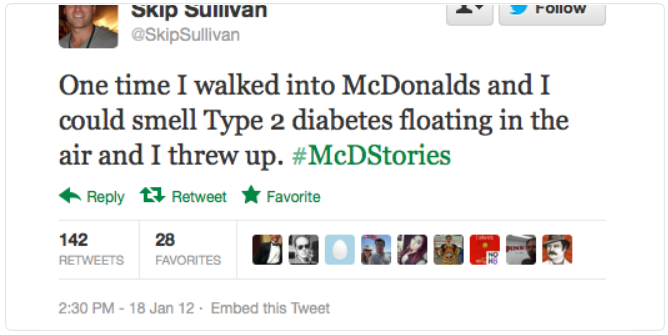
But if the questions are too open-ended you may get McDonalded. They asked followers to tell stories about McDonalds using hashtag #McDStories — and it didn’t work out so well.

McDStories

If you have a brand strategy (One claim, 3 proof planks), and manage your social media program with the intent of putting deposits in the brand bank, you should be okay. Then, you will be asking questions you know the answers to (ish).

Peace.

Insight mining.

0

In advertising the real money maker is the creative. That’s what everyone talks about. That’s what marketers spend most of their money on. Creative creates most of the wealth in marketing and all of the wealth on the agencies side. The fuel for great creative is consumer insight. Notice I didn’t say insights. Lo, there are many insights to clog the mind of the brand or account planner. Many insights to confound the creative director or creative content builder.

mining tools

The role of the brand planner is to find a single insight that can be leveraged into a compelling selling proposition. Rosser Reeves can call it a Unique Selling Proposition (USP), Al Ries can call it positioning, any goober with a WordPress account can call it what they like (me included), but great creative doesn’t start until a single, powerful, clean insight is unearthed and frees the creative mind.

A powerful insight is pregnant with creative possibility. It can help organize an army of sellers. It can brainwash the tired huddled masses. It can launch an organizing principle that redistributes marketing wealth, unlike any TV commercial ever has. Apple’s 1984 included.

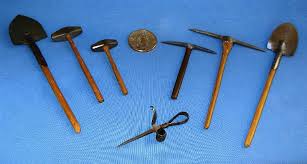
So you unsung insight miners take heart. Keep shoveling, mine till your fingers hurt, then cull, cull, cull until you find that emerald. It is so worth it.

Peace.


The paper paper is here to stay.

0

I love technology. I understand its transformative power but also its ability to alter the future tense. The future we can’t see. I say this so you won’t think me a geeze.  newspaper I was on train last week with some neighbors and we were talking about reading the news on iPads. The neighbors liked reading on their tablets. I am a fan of the paper paper. I’ve had this discussion before but never really thought about my side of the argument. Sure the paper paper uses natural resources. Sure you can bookmark and word-search on a tablet. The paper paper is unwieldy to some. But one thing you can do with the paper paper that you can’t with an electronic story is see a thousand words of the story in one huge folio view. With a broadsheet paper like The New York Times, I can go back to a piece of data or a person’s name without missing a beat. Muscle memory reminds me where on the page the content was, e.g., lower left, mid-right, previous page. That’s hard to do with a tablet. Tablets are so linear. Paper papers or a bit more for how people really read. Reading news and analysis is more chaotic. It’s more twitchy. (Google Fast Twitch Media.)

The reading experience is different using a paper paper. By tearing out passages or pages and leaving them in piles on my desk, in the bottom of my backpack or on my dresser, it reduces my footprint of digital notes, URLs, tags and logs…of which there are many. For me, the usability of the paper paper — crumbs, coffee spills, folding routines and all – provides a richer experience. A different experience. For me, a better experience. I think the paper paper is here to stay. #justme. Peace.

Mommy, what’s a radio?

0

Last Christmas I went into a Radio Shack looking to buy a good FM radio. I was trying to get my mother to listen to NPR in her kitchen where she can only get A.M. radio and has had to listen to a station (WOR) targeting the older set with let’s just say less than stimulating programming.  I asked the salesperson where the radios were (at Radio Shack) and the she directs me to two possible areas, one of which was correct. As far from the front door as you could get.

The selection was horrendous. Two brands — none of which I was familiar with. No Sony. No GE.  Pathetic. I left and went to Best Buy and found one Sony model. Don’t buy radio station stock is the moral to this story.

As Radio Shack tries to organize its way out of insolvency, with a hedge fund at the helm, one of the questions posed is “Should we rebrand?” “Should we hold onto the old name?” AT&T used to be America Telephone and Telegraph…someone smart over there decided telegraph was not a technology forward name and opted for change. So the answer to the new guard at Radio Shack is a resounding “yes.”  A new name is in order. And let’s look beyond the dashboard for a name shall we?

I should add a very big good luck. From what I’m reading of some of the partner decisions so far, they’re going to need it. Peace.


McDonald’s New Man of Action.

0

Steve Easterbrook, McDonald’s new CEO is fighting a battle on two fronts. One franchisee, quoted in today NYT, said store sales have been “horrible.” Overall, for stores opened at least one year, February sales were down 4% (February, remember, is a short month). In addition to poor sales, McDonald’s has been dinged in the media for paying low wages.

Mr. Easterbrook, who recently started his new job as CEO, has come out with guns blazing. Ballsy. And needed. He’s raising wages and adding benefits at corporate stores, putting pressure on franchise stores to do so. He has extended breakfast all day (couple of bumps in that road) and decided to use artisanal bread on the grilled chicken sandwich. He has also stopped serving food with maltodextrin (that must be good). He’s shooting in many directions; directions that purport to hurt profit. And it feels a little disorganized…but times are tough. Were he to simply fix the menu, it might not be enough. Were he to correct wages, not enough. Improve corporate responsibility, not enough.

McDonald’s, to steal a phrase, is too big to fail. It’s not too big to have some tough times though. Mr. Easterbrook is scrambling a bit, but will find his way. He’s certainly not a man of inaction. Peace.  

OrderNet of Things

0

Yesterday I tweeted about the OrderNet of Things. The phase is obviously borrowed from the Internet of Things, aka IoT. It refers to Amazon’s Dash Button. I thought the button was either named after the P&G detergent, but oops that’s Tide…not Dash. (Dash was discontinued in 1992. Brain fart). I also wondered if it was named after Anil Dash, the social media and technology commentator. Again, prob wrong.

dash button

No matter, the dash button is a little USB sized button, attached to the internet that allows one to replenish stores as quickly as Amazon can deliver. The Tide button can be affixed to the washing machine. The Pampers button to the baby’s diaper pail.

The OrderNet of Things – things being consumables — may be the killer app of the IoT.  Yet the big winner will be delivery services. Perhaps the U.S. Postal Service will make a comeback. Maybe Amazon will buy FedEx.

Groceries and consumable need to get into the house. One-at-a-time, these deliveries don’t make sense from an environmental stand point, but American’s love to push buttons. I see this as a cool fad. The idea to have an idea. It’s certain to be more of a luxury purchase until we figure out how to scale it, find economies and waste less gas. It’s still cool. The OrderNet of Things.

Peace.


Brand Strategy Warranty.

0

Brand strategies for my clients come with a lifetime warranty. That is to say, if a client takes a strategy to an agency to execute “buildables,” I am always available to provide feedback as to whether the work is “on” or “off” idea. Brand strategies at What’s The Idea are one idea, three proof planks, an organizing principle that allows brand managers to look at work and quickly tell if it makes a deposit or withdrawal in the brand bank. 

Agencies (ad, digital, social, other) are notorious for doing their own thing. For creating their own logic that supports the work. Once it starts, it seeps into all the marketing and dilutes the plan.

Campaigns and agencies come and go, but a powerful brand strategy is indelible. And defensible. My warranty.

Peace.