Mommy, what’s a radio?

0

Last Christmas I went into a Radio Shack looking to buy a good FM radio. I was trying to get my mother to listen to NPR in her kitchen where she can only get A.M. radio and has had to listen to a station (WOR) targeting the older set with let’s just say less than stimulating programming.  I asked the salesperson where the radios were (at Radio Shack) and the she directs me to two possible areas, one of which was correct. As far from the front door as you could get.

The selection was horrendous. Two brands — none of which I was familiar with. No Sony. No GE.  Pathetic. I left and went to Best Buy and found one Sony model. Don’t buy radio station stock is the moral to this story.

As Radio Shack tries to organize its way out of insolvency, with a hedge fund at the helm, one of the questions posed is “Should we rebrand?” “Should we hold onto the old name?” AT&T used to be America Telephone and Telegraph…someone smart over there decided telegraph was not a technology forward name and opted for change. So the answer to the new guard at Radio Shack is a resounding “yes.”  A new name is in order. And let’s look beyond the dashboard for a name shall we?

I should add a very big good luck. From what I’m reading of some of the partner decisions so far, they’re going to need it. Peace.


McDonald’s New Man of Action.

0

Steve Easterbrook, McDonald’s new CEO is fighting a battle on two fronts. One franchisee, quoted in today NYT, said store sales have been “horrible.” Overall, for stores opened at least one year, February sales were down 4% (February, remember, is a short month). In addition to poor sales, McDonald’s has been dinged in the media for paying low wages.

Mr. Easterbrook, who recently started his new job as CEO, has come out with guns blazing. Ballsy. And needed. He’s raising wages and adding benefits at corporate stores, putting pressure on franchise stores to do so. He has extended breakfast all day (couple of bumps in that road) and decided to use artisanal bread on the grilled chicken sandwich. He has also stopped serving food with maltodextrin (that must be good). He’s shooting in many directions; directions that purport to hurt profit. And it feels a little disorganized…but times are tough. Were he to simply fix the menu, it might not be enough. Were he to correct wages, not enough. Improve corporate responsibility, not enough.

McDonald’s, to steal a phrase, is too big to fail. It’s not too big to have some tough times though. Mr. Easterbrook is scrambling a bit, but will find his way. He’s certainly not a man of inaction. Peace.  

OrderNet of Things

0

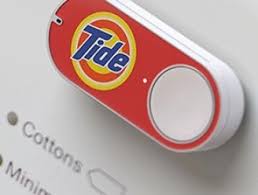
Yesterday I tweeted about the OrderNet of Things. The phase is obviously borrowed from the Internet of Things, aka IoT. It refers to Amazon’s Dash Button. I thought the button was either named after the P&G detergent, but oops that’s Tide…not Dash. (Dash was discontinued in 1992. Brain fart). I also wondered if it was named after Anil Dash, the social media and technology commentator. Again, prob wrong.

dash button

No matter, the dash button is a little USB sized button, attached to the internet that allows one to replenish stores as quickly as Amazon can deliver. The Tide button can be affixed to the washing machine. The Pampers button to the baby’s diaper pail.

The OrderNet of Things – things being consumables — may be the killer app of the IoT.  Yet the big winner will be delivery services. Perhaps the U.S. Postal Service will make a comeback. Maybe Amazon will buy FedEx.

Groceries and consumable need to get into the house. One-at-a-time, these deliveries don’t make sense from an environmental stand point, but American’s love to push buttons. I see this as a cool fad. The idea to have an idea. It’s certain to be more of a luxury purchase until we figure out how to scale it, find economies and waste less gas. It’s still cool. The OrderNet of Things.

Peace.


Brand Strategy Warranty.

0

Brand strategies for my clients come with a lifetime warranty. That is to say, if a client takes a strategy to an agency to execute “buildables,” I am always available to provide feedback as to whether the work is “on” or “off” idea. Brand strategies at What’s The Idea are one idea, three proof planks, an organizing principle that allows brand managers to look at work and quickly tell if it makes a deposit or withdrawal in the brand bank. 

Agencies (ad, digital, social, other) are notorious for doing their own thing. For creating their own logic that supports the work. Once it starts, it seeps into all the marketing and dilutes the plan.

Campaigns and agencies come and go, but a powerful brand strategy is indelible. And defensible. My warranty.

Peace.

American Luxury Car Brands.

0

The Ford Motor Company is reviving the Lincoln Continental, a car it discontinued producing in the U.S. in 2002. Last fall the Lincoln Continental begin selling in China and seems to be doing well.

The Cadillac family of luxury cars has long eschewed the use of brand names in favor of numbers and letter. A sad branding mistake. I tried hard to think of a Cadillac brand but couldn’t. STS comes to mind, but in my mind’s eye I’m not even sure what one looks like. A Lady Gaga shoe perhaps? So I Googled Cadillac brand names and Wikipedia brought me to a page filled with numbers and letter and only a couple of names: the Fleetwood (in the 50s), Coupe DeVille (60s) and the El Dorado (80s). How quickly we forget.

The alphabet soup of model names Cadillac uses is, I suspect, intended to shine the light on the master brand.  It’s not a good move.  The Escalade was a great brand name, so we know they can do it. Maybe they’re waiting for a really nice car design before launching a new brand name?

Moving the Cadillac corporate offices to SOHO in NYC was a good first move. I’m thinking some nice designs and names aren’t too far away. Peace.  

PS.  The current Lincoln names are no better, MKC, MKS, MKK. Oy. At least they have the Continental brand to work with.

A Tip for Heinz and Kraft.

0

The Kraft Heinz merger being orchestrated by 3G and Warren Buffet is a financier’s dream. Lot of money to work with. Kraft, a stalwart in the US. Heinz a global consumer goods company. A number of billion dollar brands to work with – brands like Kraft Macaroni and Cheese and Heinz Ketchup. Lots of room to make big topline money and big bottom line cost cuts.

The only downside we’re hearing about is the fact that processed foods, high in sugar, salt and other less than healthy additives, are supposedly under consumer attack. And those are the sweetspot of Kraft. Certainly we’re reading about Millennials trying to eat healthier. Darren Seifer, analyst at market research company NPD says this trend toward healthier eating will be slow in coming. The word he used was “tectonic.” I beg to differ. Consumption patterns, can change at the drop of a hat with good reasoning. Once we get the lobbying money out of the way, and consumers understand the health risks of carbonated soft drinks, high fructose corn syrup and processed food stuffs, consumption habits will change.

And then, to adapt, R&D will change leading to reformulations. Were I Warren Buffet or Jorge Paulo Lemann, I’d take some of my hard earned and invest it in next generation, healthier-for-you food products today. Look at the growth of Hain Celestial. Last I looked their portfolio was growing by double digits. Peace.


Live Mas Indeed.

0

In marketing there are “does” and “talkers.” You can’t become a talker without first doing but after you get your talker stripes it becomes easy to go on the speakers’ circuit. One of my favorite brand and marketing “doers” is Taco Bell’s CMO Chris Brandt.

biscuit taco

First off, he gets branding. He understands when you have a powerful brand idea, in his case “Live Mas”, you need to articulate and share it. Everywhere.  By enculturating it inside a company, it then seeps out every pore. Next you need to innovate. Innovation provides learning.  And marketing is nothing if not constant learning. With all deference to the people selling agile this and agile that, you also need to know when to pull the plug – as Mr. Brandt has with the waffle breakfast taco. This time last year it was touted as the company’s largest new product launch. Today it has morphed into a Biscuit Taco. (Maybe use a little American maze in the recipe?) The point is, Mr. Brandt’s engine is always running. Good thing because he’s in the retail fast food business.  Next to selling door to door, retail offers the most immediate response to effective marketing. One year of waffles and Mr. Brand knew he had to make a move.

Lastly, Mr. Brand is using a hot ad agency, Deutsch-LA. These Westies are doing some great work. Traditional and digital. They may not get branding strictures with the vigor of Mr. Brandt, but they don’t have to. As long as they have him to drive the taco bus. Peace!


The ACA is Working. Now Let’s Prove it.

0

Readers know my branding equation has three variables: claim, proof planks and proof points. The Affordable Care Act has one primary goal: improve patient outcomes. The big honkin’ goal is to make America less sick. If it works, the cost of care will go down. America spends $18-19 of every $100 on healthcare. If we prevent disease we can cut that number substantially.

We are in year 2 of implementation of the Affordable Care Act and the CMS (Center for Medicare Services) and most other number-gatherers are hard-pressed to find evidence of improved population health. We have lots of claim little proof. I understand big data takes time, but frankly, I think we’re not looking hard enough.

Rather than spend hundreds of millions on web site usability, call centers, systems integrators and community outreach, can’t we cut off a piece of that pie and hire 100 data analysts whose sole mission is to quantify health improvements in communities with improved health services?

As more patients have access to physicians and more patients are educated in ways to prevent high blood pressure, diabetes and heart disease the numbers will improve. Daily. We just have to turn loose some data nerds. The data is there – it’s probably at Aetna, Blue Cross and United Healthcare – we just have to find it. And publish it. And celebrate it.

We have the claim right, now it’s proof time. Peace.


Brutal Mistake.

0

If you are paying an agency to do social media marketing for you, you are making a brutal mistake. You are losing an opportunity to learn from your customers. And you are giving that opportunity to a partner who is as loyal as its last retainer check.

Never outsource an opportunity to learn from customers.

If doing social media yourself, that’s a good start, but you need a plan. Having a plan helps with listening. It helps with customer care. Content development. Analysis. And engaging.

I created (but have not yet fielded) a piece of research indented to find out how many social media programs are guided by brand strategy. My guess is not a large percentage. All the dashboards in the world, all the HubSpot portal tools and tutorials, all the competitive alerts are no substitute for a plan tied to brand values. Brand values that prioritize business-winning values.

Engagement is not a business-winning brand value. Clicks are not a business-winning brand value. Coupons redeemed aren’t either.

Social media programs are extensions of brand strategy. Plain and simple. If there isn’t a brand strategy, there isn’t a good social program. If there is a brand strategy and it’s not in harmony with you social media program you are sailing at the whim of the wind, with no destination in mind. You are making a brutal mistake. Peace.

How to Fix Bank Reputations.

0

Here’s a fun little video showing what a handful of European kids think of banking as a profession. Very cute, unless you are a banker. I suspect bankers aren’t that offended, but then I grew up in the advertising business where “ad man” was one rung above car salesman on the bottom of the trusted jobs ladder. Bankers probably say they are misunderstood.

If you read the news there is an awful lot of press about banks and their billion dollar fines. Not that kids read that type of stuff, but their parents do. Talk around the dinner table must trickle down.  So if you are a bank, what to do? How do you slow the negative perceptions kids are faced with about banking? Well, you could give a 50 million dollars to a blighted city and hold a press conference. Or, rather, you could invest in programs to help kids understand the value of saving. Banks don’t focus on saving, they focus marketing efforts on borrowing.

What do you think would happen if one bank devoted half of its budget to messaging around saving? Would its borrowing numbers go down? I suspect not. I think some education about saving and financial proficiency would make consumers trust that bank more. And when you trust someone more, you’re more apt to borrow from them. And they more apt to lend you to.

Bankers can move the dial; they just need to flip some priorities. Peace.