Marketing

    A Ride Sharing Growth Opportunity.

    0

    I bet if you parsed the records of Uber and Lyft you’d find that millennials comprise the lion share of users.  A good early adopter strategy. As their parents begin to see the value, they add accounts and the universe broadens. I, for one, have an Uber account but have not yet used it, yet a number of my friends have.  Do you know which market segment is really ripe for the picking? 80 year olds.  There are about 18 million US men and women over 75 years of age and they like to go places. They like their independence. Many are driving cars. Cars with door dings, abraded paint, and aching side view mirrors.

    This senior market is perfect, but for the technology. How about a landline telephone interface? A special GPS chip, like a grocery store swipe? Cash payment options? Seniors like a deal, so perhaps Uber and Lyft might consider special blue plate pricing specials.

    As the ride sharing category gets more competitive, players will be looking for low-cost ways to grow market universe. This one is a no brainer.

    Peace.


    It’s Evolution Baby.

    0

    Just as Wyoming is transitioning from a coal mining state to a wind farming state, so will change the advertising business. I was one of the first people who poo-pooed the death of the TV Advertising commercial. When HubSpot came out proselytizing inbound marketing would replace advertising, I giggled. It wasn’t too much longer that they were investing in TV ads themselves to build business.  But conversely, back in the 90s, I asked Bob Cohen “Where are the online spending predictions?” His answer? “Too small to track at this time.” Bob was a McCann employee and the world’s leading ad spending economist.

    The not so simple fact is advertising has been change irrevocably by online. And by the algorithm. Putting active queries into the marketing mix has up-ended everything. I’m not exactly sure what the 21st century ad unit of choice is but it will be somewhere between a video ad and a data-driven delivery system. And Google will not hold on to all the business the way it has today.  As Pearl Jam says “It’s evolution, baby.”

    So we must begin to plan and ready ourselves for the future.  I’ve been writing and getting some traction around the comms planning tool Twitch Point Planning. I’d love to work with a smart brand to develop a Twitch Point program. It would be merely a step but as a mentor of mine once said “The idea to have an idea is sometimes more important than the idea itself.”

    Let’s go! Peace.           


    Breaking Rules in Brand Planning

    0

    10 commandments

    There’s a saying I coined as a kid in the business I find to be kind of profound, “Just when you think you know something about this business, someone comes along to prove you wrong.” It speak to absolutes in marketing, advertising and, yes, branding.

    Human behavior is not like other sciences. Sure you can predict behavior but humans are nothing if not unpredictable. Ads that are deemed by opinion leaders to “suck,” work like crazy. New products you wouldn’t buy with an enemy’s money, sell like hotcakes. Product names that make no sense, become household words.

    Brand planners must understand that exceptions exist to every rule. Embrace them and encourage them.  How?  Use your gut. Guts matter. Experienced guts may matter more, but tyros can cash in on big ideas – counterintuitive ideas – just as well as the seasoned.

    Serendip-this. Peace.                                                              


    High Def Brand Planning Nixes Google Planners.

    0

    I was just reading an article on the correlation of mass attacks and spousal abuse citing examples from years ago and continents afar — stories about which I’d never heard — and it dawned on me that with a few clicks of a keypad and the help of Google a reporter can do months of homework in minutes. Google is a freaking crazy research utility. Journalists use Facebook and Twitter to quickly source people for stories.

    When in college I read The Modern Researcher by Jacques Barzun to help navigate libraries, newspaper and magazine archives to learn effective research methods. Today, with Google and Wikipedia you can be done before getting half way to the local library.

    sitting at deskAs a brand strategist, Google offers immeasurable advantage. But there’s a term I’ve come across “Google planners” and it’s not a very attractive descriptor. It refers to brand planners who never leave their desk.  

    Even if they use videoconferencing to conduct discovery interviews (another cool tool), Google Planners need to sit next to their interviewees to get higher def reactions. And emotions. Google is a wonderful assist, but Care-abouts and Good-ats are best mined in person, in situ, on prem, and up close. You gots (sic) to get out of the building boys and girls. Stim is the key to great ideas. And stim is multi-dimensional.

    Peace.         


    Twitter’s Secret Sauce…Posters.

    0

    twitterOriginal thinking and original content is what makes Twitter great. Sadly, the other thing that makes Twitter great is the reposting of that original thinking – a behavior called retweeting. Were I to guess at the number of Post (original content) versus Pastes (reposters of OPS/other people’s stuff) it would probably be 15%-85%.

    Twitter has a growth problem, says the business and investment community. I disagree, but I’m not of that community. One suggestion I would make to Jack Dorsey and team is to elevate in importance Posters and Poster behavior. Retweets of OPS is a great viral tool, insuring dispersal of content through the Twitter web but it’s not the center of gravity of Twitter. That lies in originality of the 140 character impulsive share.

    I choose whom to follow based upon their Poster/Paster behavior. If their feed it filled with OPS and Retweets, I tend not to add. They are social fidgets (okay, that’s too harsh) and curators.

    In my business, where I’m always looking for influencers, opinion leaders and smart observers of brand and marketing insights, I hunt for Posters.

    Dial up the Poster amplitude Mr. Dorsey and you may dial up your financials.

    Peace.


    Microsoft and Vision Purchases.

    0

    I’m not sure how I feel about Microsoft’s plans to purchase LinkedIn.  Microsoft’s vison as a professional cloud co. sounds like it should marry with LinkedIn’s professional network co., but to date Microsoft just doesn’t seem to have a lot of luck with vision purchases.  I thought Nokia would end up a great idea. My post about lowering the prices point for smart phones around the globe never happened.  

    LinkedIn lost money last year. Jeff Weiner and Reid Hoffman are so use to success, it must have been a smelling salts moment.  The buyout money was too attractive. When you are on a rapid rise you don’t have time to think sale. As the corner turns however one starts to consider.

    I hope LinkedIn stays independent (under Microsoft) as Satya Nadella suggests. I’m worried it won’t. And don’t get me wrong, I am a Microsoft fan. Still a believer in the Windows phones. Still a big believer in Mr. Satya’s productivity focus.  But it’s the “buy your way to success” mentality that is the concern. It’s not very Gates-ian.  Bill Gates was a ruthless builder.

    Still not sure about this purchase. It’s ballsy. If pushed to make a bet, I’d sadly say nay.

    Peace to all.                


    Brand Strategy Framework.

    0

    I once gave a creative brief template to an account manager who took it to a meeting at Adelphi University where he sat with the marketing lead and, together, tried to fill it out. In the midst of the meeting they called me to clarify one of the points – probably brand essence or core desire or some such.  I was flabbergasted.  Fruitcake. Not him, me; for not explaining the briefing process well enough.

    A brief is a framework to get to an idea. I’ve lived with mine for years and it’s not too much different than it was when purloined from Peter Kim and McCann Erickson in the 90s. It has a nice linearity to it and helps me down the road to a selling idea.  

    There are often many sparks for the idea within the brief, but it is the planner who himself or herself understands which one is going to birth the idea. There is always one insight that just hits the brain like a freight train. 

    Some planners eschew frameworks so they can be more fluid. That’s okay. If it works — to each his own. We gather, we learn, we think, formulate, test and finally decide.

    Getting there is all the fun.

    Peace.                  


    Stitch Fix Brand Planks

    0

    stitchfix

    I’ve been writing a lot lately about how brand strategy is the perfect intersection of customer care-abouts and brand good-ats. Earlier this week I posted that it’s best to have good-ats as part of company DNA rather than just build them based on customer needs research.

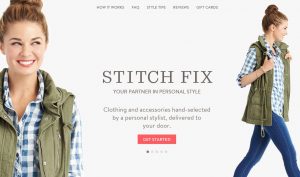
    Enter Stitch Fix, a very cool clothing start up that melds the best of the online web retailing with features of brick and mortar clothing stores. Stitchfix has built its business around convenience, surprise and renewal. It’s genius. And addictive.

    The brand planner in me loves what I interpret as the company’s three brand planks: “personalized,” “better every time,” and “on your time.” This organizing principle for product, experience and messaging is unique and, if done well, highly defensible.

    The website lists these three things as benefits, which is another word for care-abouts.  They are presumably brand good-ats but time will tell. This is a case where a start-up has to build the good-ats as the business matures. And course-correct in real time.  But you can see how having a plan, an organizing principle and commitment to brand strategy can make it work.

    If Stitch Fix gets benefit delivery right it is going be a high-flier.

    Peace.


    Popping New Brand Strategy Questions.

    0

    popping the question

    What’s The Idea? readers know my brand planning framework revolves around the mining of proof.  Proof of actions, deeds and results. But how does one mine for proof?  Google might use the algo. Me? I ask questions. Done well, questions are the lubricant that bring forth critical values.

    I’d be fibbing if I told you the battery of questions I use is unique to each investigation. That said I’m constantly adding, subtracting and thinking of question to help in discovery. Following are two new questions worth sharing.

    What about this product or service heroic? Heroes are what make great books and movies. It’s what kids aspire to. Saviors of the neighborhood. Heroes are what make countries, religions and cultures great. Heroes are passed down generationally. This question requires thought and may take some prodding. Best to ask it early in the interview so it can be thought about if not readily answerable.

    What about this product or service will stand the test of evolution? Students of natural selection understand the scientific order that culls out bad traits and preserves good. Genes that improve an organism will, over time, outlast the destructive ones. This question is meant to find brand strengths through a new lens. A scientific lens.

    I can’t wait to pop these questions. Always be learning. And evolving.

    Peace.


    Fearful Advertising.

    0

    Memorial Sloan Kettering Cancer Center is one of the greatest healthcare organizations in the world. Perhaps the greatest. As a result, it has also become a powerful, powerful brand. It is exactly what it is…and lives up to the brand claim “the best cancer care anywhere.”  Its words spread through stories and proof. Patients and caregivers syphon proof off their experiences and share. (Branding revolves around “claim” and “proof.”)

    MSKCC more scienceA couple of years ago MSKCC appointed new advertising agency Pereira O’Dell. I complimented the shop and client on the new brand strategy claim “More Science. Less Fear.” Having worked in healthcare branding for a long time, studying the claim and proof arrays of the top area hospital systems (disclosure: I penned one of those strategies), I rubbed my hands together in anticipation of some good work to follow.

    This past week I was listening to an MSKCC radio spot and was disappointed to hear talk about serving the “mind, body and soul” of patients. This type of copy is what you’d expect from a religious-based group or a second tier hospital. From a system that can’t differentiate based on the science. This ad hurt MSKCC in two ways. It didn’t deliver on the brand promise, wasting money, time and resources, but more importantly it dumbed down the sanctity of the brand, making MSKCC peddlers of healthcare marko-babble like many others.

    If anyone can educate the populace about the science of cancer care, using real proof, it’s Memorial.

    This isn’t that hard. Find your claim and prove it every day.

    Peace.