Marketing

    Best Buy Default.

    0

    I love making predictions.  When I started disagreeing with Barry Judge, CMO of Best Buy, a few years ago about marketing and brand management, implicit in that disagreement was that Best Buy would have earnings troubles. You see, Mr. Judge jumped on the pop marketing band wagon proclaiming “companies don’t own brands, consumers do.”  My response was this view was lazy and opened the door for disorganized brand management. Even a number of P&G digitists were agreeing with this fallacious notion.

    Best Buy’s net income is down 30% this quarter, all due to price cutting.  If your name is Best Buy and you ask customers what they want they’ll say “coupons and low prices.” If you don’t create another value for your customers they default to price.  And when customers default to price you’re not marketing, you’re simply selling.

    Mr. Judge and his army of Twelpforcers and sales assistants needed a plan. They were in the right neighborhood (providing assistance), but bounding about without a motivation.  Had they a plan, had someone at the top managed the brand rather than turned it over to the masses, Best Buy would be killing it now as we slide step out of recession. 

    The good news for Mr. Judge is it’s not too late to fix this thing. He has more data, more inputs and more mindshare than he knows what to do with.  If he organizes his house with some serious brand management chops, next year Best Buy won’t be covering up price tags to fend off the smartphone price scanner apps, they’ll be smiling with gold teeth. Peace.

    Mine the Goodness.

    0

    A friend of mine recently told me his family has not used a credit card in 8 years.  Sounds as if 8 years ago his family was spending a little beyond its means. Then something happened. Sanity happened.  The same insanity that drove my friend’s family to the brink has infected gov’ts and corporations alike over the past couple of decades and though I suspect the U.S. government hasn’t completely seen the light, businesses are starting to. Certainly families have.

    With unemployment creeping in the right direction and markets beginning to slide step forward, my gut tells me this recovery will be tempered in a positive way and we’ll all exercise more restraint. Business owners and families will be much more mindful of expenses.  Expenses will be monitored more closely and the work supporting them will be harder work — smarter work.  Case in point: Vermont.  Always a state known for thriftiness and hard work, Vermont was devastated by hurricane Irene.  Mile and miles of roads and bridges were washed out in late August and the expectation of repair was $1 billion and a year to complete.  Today Vermont is almost completely back to normal road-wise and the price tag looks to be more like $200 million.

    How?  The recession made us stronger, smarter, more willing to work together.  Certainly it did in VT.  Now that goodness needs to spread. A goodness born of tough times. Let’s mine that goodness y’all.  Peace!

    Two Lessons From One Conversation.

    0

    I love the Metropolitan Diary column, Mondays in The New York Times.  It provides wonderful stories and insights about the NYC experience and beyond.  Today it also shared a brand planning lesson. With all this marko-babble about “the conversion” in marketing today, here is a real slice of life that takes unlikes and  near-likes and starts a real conversation. Are these people selling? In a sense, yes. Peace!

    Dear Diary:

    About six weeks ago, I was on a very crowded subway coming home from my school, where I am in ninth grade. I was standing next to a woman wearing a head scarf and a tall man wearing a taqiyah (a Muslim skullcap).

    He turned toward her, said, “Salaam alaikum,” and asked where she was from. “Iran,” she replied.

    The man said he was from Palestine. Just then, another woman turned around and said, “I’m from Egypt.”

    “Wow!” the man said. “We’ve got the whole family here.” They started talking about their jobs and what had brought them to the States.

    The man said that he worked for an antidiscrimination organization intended to prevent prejudice against Muslims. He handed the two women leaflets about how to prevent discrimination, and I guess he noticed me watching and listening because he offered me one as well.

    “Thank you very much,” I said, “but I’m Jewish.”

    “Doesn’t matter,” he responded. “You have the same civil rights as we do.”

    I took the leaflet just as the train got to my stop. With a “shalom” and a “salaam alaikum,” we bid each other goodbye.

    Sam Mellins                                

    Too much creative, not enough creatives.

    0

    According to an article in The New York Times “The government says that today 23 percent of fish stocks are not at self-sustaining levels at current fishing pressure.”  That means we are fishing those species into negative territory and they will eventually become extinct.  I wouldn’t be at all surprised to find this same affliction occurring in the advertising business.  

    For the sake of this discussion let’s just say there are a limited number of people effective at making terrific, original creative – the type of work that people talk about and that actually motives purchase. The fish.  Let’s say there are 5,000 of these fish.   They may reside at large shops, small shops, digital or be freelancers.  The problem is there are millions and millions of assignments out there. Every day. From a simple Google Adwords text ad to a Super Bowl commercial.  Who is doing that work?  Not the 5,000 fish everybody is trying to land.  Too much work for them. All the other swimmers in the water are doing the work.  Before everything became fair game for advertising messages and everything became media, there were almost enough creative minds to go around.  Today there is not. Creative is being done by anyone with fingers (and I apologize to the digit-challenged population.)   

    Add to this the fact that the real fish – the 5,000 – are in such demand that they have no chance to mentor or teach. Not until they are toasted; at which point they are, well, toasted.

    So what’s the answer? The web, what else?  And vision. We need to have the fish set aside some time to share what they know with all the other swimmers.  Dave Trott blogs daily and is worth a read. No toast he.  David Droga. David Angelo. Tor Myhren. Please step up. Please take some time to replenish the sea. Use the web. Help the young and those willing to learn. Or the business will slide further into a pond filled with farm raised creators and tasteless pellets.  Peace.

    Demand Creation. Really?

    0

    I read last week that a fan may actually be more valuable than a customer. Initially, I nodded my head thoughtfully but now I’m back now.

    One of the first predictors of marketing success is the degree to which people need your product.  A second predictor is that people want your product.  Sadly, consumers are being sold things today they don’t need or want. Marketers often spend money creating demand where none exists. Is it any wonder John Wannamaker’s famous line “Only half of my advertising is working” still resounds? Educating consumers as to what they need is not the job of advertising. Frankly, it’s what know-all mothers-in-law do and it is annoying. Providing a product to meet an existing need, on the other hand, is a great place to start.

    Everyone has a shower.  All shower tiles and grout need cleaning. Good place to start a business. Invisible germs in the shower that people don’t know exist, is an educational effort. And if those germs aren’t harmful, why do they need to be killed? Not a good business.

    Marketers need to spend more time on customer need and product innovation and less time tweaking market share through message innovation. It makes the marketing agents look bad.  And it wouldn’t hurt for a good ad agency or two to turn down a product assignment every once in a while because the product is meaningless. That’s the way to create an agency A list. Peace! 

    Is it not true that the opposite of promotion is…

    0

    Have you ever noticed that law firm earnings rarely make the papers?  Or that gazillion dollar law firm names are unknown by the masses? We really never think about big corporate law firms. As Occupy Wall Street targets the banks and focuses on corporations that do not pay their fair share taxes, lawyers walk back and forth with nary a glance. 

    A friend of mine is in operations at a law firm in NYC and very involved in build-outs and office relocations. His firm is in a semi-historic NYC building and they are renovating like a dookie. Conference rooms like museums, two-story, south-facing offices that would make a king blush.  Corporate and high-end law firms are the subject of good TV drama, but fly under the radar because they are private and in the business of stealth and secreting information. They are also in the business of reverse brand management.

    Staying out of the public’s eye and keeping clients invisible is an art — and lawyers do it best.  Perhaps some large communications companies who build reputations for a living should hire and study top law partners to understand the enemy.  The enemy being the opposite of promotion. Perhaps then we can invent a few new ways to sell.  Peace.

    YouTube. Health Info On-Demand.

    0

     One of the fastest growing content areas on YouTube (data source: me) is healthcare channels. Hospitals and health systems are uploading talking head videos at an amazing rate. One large nationally recognized hospital recently uploaded 25 videos by lunchtime.  YouTube has a way to go in perfecting its channel tools but visitors can search by clinical area, date added, most viewed, and top rated.

    Healthcare provider companies are not known for their marketing expertise — they are too busy saving lives — but the move into YouTube is a smart one.  Do you know anyone who doesn’t have a family member with a health problem? The quality of these videos is quite good, albeit a bit over-polished.  If you remove the occasional singing video encouraging employees to wash their hands, you’re left with a body of work where humans talk to humans in understandable English, removing the magic.

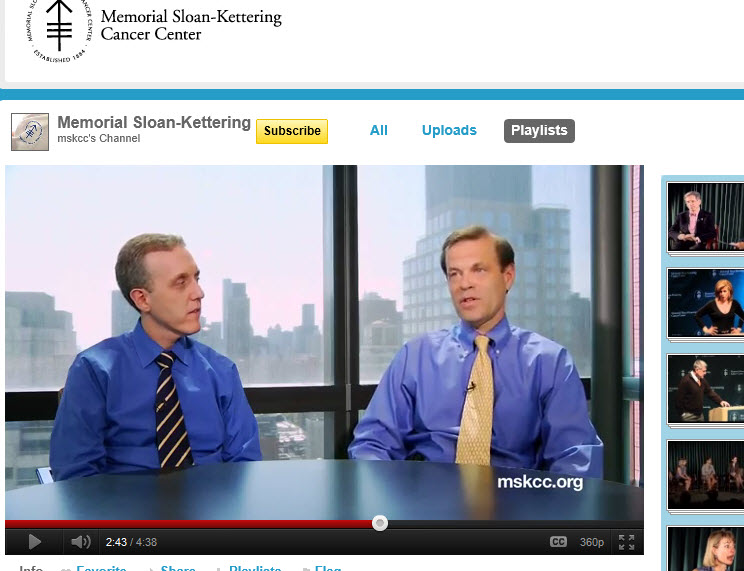
    Personally, I find the videos that don’t feel too scripted the best. Two docs at Memorial Sloan Kettering were talking on camera, sans make-up, and it felt very different from the norm, very real. The hospital has a reputation for clinical coolness and this video worked to change my attitude.

    The ROI problems is this — these videos cost a good deal of money to produce and some get 28 views while others get 28,000 views.  As these channels grow in search sophistication and the video producers evolve, we are going to see some serious, serious advances traffic. This is big, important business. Peace! 

    Some Assembly Required.

    0

    Biophilia is the name of a just released Bjork art project. An album available only on the iPad, this, by some accounts, is the first consumer controlled piece of music released to the world.  Though it will take some arrows and may not be a world class compilation of music, it’s what excites me about technology. One plus one does sometimes equal 3.

    Much will be written about the new album, but one thing that is undeniable is it breaks new ground.

    I recently worked on a project in the contemporary art world and Bjork’s project inspires me to wonder if consumer controlled paintings and mash-ups might be in our iPad or online future?  Any person who ever took an art class in college and created a painting knows it is not easy. Though, with the ability to copy and paste art elements from photos, online galleries and stock images together on a screen and create a print or canvases – that’s some cool.  No more pictures of cats next to fruit bowls in the dining room.

    Consumer created content is part of the web’s DNA. Art appreciation is part of human DNA. New doors open every day and the doors that open to the art and music world are richer than most. Peace.

    The New York Times Brand.

    0

    The New York Times, one of the top 5 brands in the world (IMHO), is beginning to get with the digital program. And the result? A profitable quarter.

    I buy and read The New York Times every day.  When I think about it, what I pay for and what I use are way out of whack.  Let’s say there are 60,000 words in any one issue of which I may read 3,000.  What kind of usage is that?  Yet I’m as loyal as a house cat.  Why?  Because the NYT has managed its brand brilliantly. It offers the world — reported and depicted without bias (save for the editorial pages) in a wonderfully written and presented format.  The Times defines news journalism as Coke defines cola.

    With the web collapsing the news cycles and citizens sharing pictures and video in real time, the Times has lost some of its news magnetism.  Until it gets it back.  It has been slow to adopt social media as a tool for tracking and reporting stories but is picking up speed. And once it catches up, it will lap citizen journalism. Someone from the Times could have been in position west of Surt, Lybia yesterday to get some original photography. Instead its photographer were in Surt.   

    How the Times gathers, reports and analyses news and stories is changing, but the branded product they serve up remains the same. That culture, that brand, that product is so tight it will never Kodak (verb.)  It has been a bit bumpy, but watching the Times find its sea legs in the digital world is going to be very exciting. Peace!

    The Thing About Twitter.

    0

    I have a pal in the wholesale fish business. This dude sells some serious fish. The finest restaurants in NYC use his product and have for years. When the BP oil spill occurred last year, it dawned on me that his hard drive (his brain) probably was one of the few that knew what would become of shrimp prices and avails in the city so I suggested he start to Tweet. My thesis was that NYC chefs indexed high for technology and twitter accounts. And if not chefs, certainly restaurant owners and buyers. Those who didn’t, could easily pick it up if it would save them face and cash. (The beauty of stellar usability.)

    The point of this story is that, commercially, Twitter and Social Media are best when providing a meaningful purpose.  For target segments that have an information need, a twitter account or Fotchbook page can be very useful. Once my pal learned the interests and needs of his Twitter followers and hashtag surfers, he could then graduate into a couple of promotional specials. “Bigeye Tuna, $6.00 a pound for the next 2 hours.” But first, he had to understand the need – to do that he had to immerse himself, feel the ebb and flow. And develop a plan.

    Twitter is an enabler, not the solution.  Sadly, the majority of people in the ether or on the speaking circuit who talk about social media talk about social media and not the solution. That’s social media 3.0 and I can’t wait. Big eye Peace!