Product. Package. Brand.

0

Product, Package and Brand are three fundamental marketing words for the 21st Century. The traditional 4 Ps of marketing: product, price, promotion and place are still workable cornerstones but for my money consumers have evolved so far and product management has devolved so far that success can not be achieved focusing on these three alone.

Product.

These days a product has to be good. No longer can you spin a shizzy product or service and be successful. What constitutes a “good” product in this era though is debatable. Especially in the states. We sell a lot of cheese (poor product) here, but because the cheese is affordable and lasts a year, people buy it. The definition of good, at the lower to middle end of the market, has changed markedly. Make it good and they will come.

Package.

Before the web, packaging was what your product arrived in.  In 2010, with people spending billions on virtual goods, goods aren’t even goods. Packaging. Point of sale packaging is still important, don’t get me wrong, but the point of sale is different. For those who do product research online the website is the package. A lot of product website homepages are built like old school product packaging: features, bulleted copy, product shots (fail), but that’s a story for another post. These days — and they are amazingly exciting days — advertising, PR and promotion are all part of the package. Access and search have changed everything. The package is now a continuum.

Brand.

Whenever I hear an art director talk about branding I head for the hills. Sure, design contributes to brand development, in a very big way, but design manicures the brand it isn’t the brand.  Apple gets this. Branding is a strategy: an organizing principle that consumers and employees share. It’s a vessel in consumers’ minds filled by an idea and proof. Products may be virtual but brands shouldn’t be. Get the strategy and consumers will get you. Peace!

PS. Anyone digging the new Google logo art on the Google home page today?

Chase What Brand Strategy.?.

0

Question: What is a brand strategy? 

Answer: A brand strategy comprises a strategic idea or claim and three support planks that vivify the claim.  Three planks, because two don’t always allow for a complete, differentiated story. Getting the idea right is key. Selling it to consumers day after day is the heavy lifting…called brand management.

Chase What Matters.

JPMorgan Chase has a very identifiable idea: “Chase what matters.”  It’s a consumer directive from a very big company that knows how to make, save and invest money. Something they already get credit for.  The idea has ballast, but so far it is only an idea. Banks have been making promises without backing them up for decades. I’m not getting a read on the Chase support planks yet – the planks that allow me to believe Chase “knows what matters” to me and that they are the bank best equipped to deliver.   

One of Chase’s neater tactical ideas lately is the “Chase Loan For Hire” program, through which it decreases small business loans by a quarter point for every new employee hired, up to three. Though I have no idea what Chase’s planks are, forensically, I might assume this tactic supports a plank titled “Meaningful borrowing matters.”  I’m not talking buy a hot tub meaningful, I’m talking something that relates to what popular culture views as meaningful. Today that’s jobs.  Nice touch.

Banking is a tough category. In my bones I feel Chase has an idea, but the jury is still out on the organization of the proof.  I’ll continue to map its planks as they become evident and share them here at What’s The Idea? Peace!

Let’s Not Call it Strategy.

0

(A self-absorbed poem about brand strategy.)

My paper is power.

My paper is freeing.

My paper creates tension.

My paper doesn’t need pictures.

My paper is musical.

My paper creates language.

My paper is rose-colored.

Always rose-colored.

My paper creates feelings.

My paper encourages doing.

My paper is your paper.

My paper quickens.

If you fight the paper…you are fighting paper.

My paper is the idea to have an idea.

Burger King Futures.

0

The Burger King Whopper is a great product. Many people, myself included, feel it is far superior to McDonald’s Big Mac.  The problem with BK has always been product consistency. One day a Whopper can be sublime – the perfect fast food burger.  Fresh, crunchy, a perfect combination of backyard BBQ, veg. and condiments (the tomatoes are always an issue in the winter), the next day it can be cold, greasy and sporting an almost fruit cocktail-like mush of ingredients.    

As a student of Burger King, I thought their investment in new broiler technology a year or so ago was going to change the fast food world. It did not. McDonald’s is still kicking their butt in consistency. Broiling is BK’s point of difference, but it won’t hold up to poor in-store execution.

Today a Brazilian consortium of investors by the name of 3G is likely to make a move on Burger King.  In my view they are buying a business and a brand with so much upside it’s scary. The new owners need to establish almost NASA-like precision, though, with regard to product quality, especially in franchise stores. Forget the advertising for the moment. Forget the children’s playrooms and store color palette.  Get the core product right, make it consistent and the category will turn in your favor. Especially as you roll out internationally. Peace!

Under Armour. I wick. I mean, I will.

0

I love Under Armour.  I do. It’s an amazing, important brand. If the company didn’t invent compression shorts, it certainly gets credit for it.  The story is great, the product meaningful, and the company with its Baltimore provenance has people rooting for it.  Sports apparel is a category alone in its ability to push through the recession and Under Armour is leading that growth. Under Armour owns the “hard body.” But image-wise, it’s operating in a competitive field with players spending a lot more money.  Gatorade and Nike were first to hard body. Though all three focus on the flesh, sinew and sweat, Under Armour focus should be on the packaging (of that body).

Women’s Sports Apparel

Now Under Armour is amping up it targeting of women, who account for only 25% of sales. It is doing so by extending with the “I will” and “Protect this House I will” brand idea.  Don’t get me wrong, the imagery and music is rousing and I love Lindsey Vonn, but the brand idea is not tight enough to slap a pair of balls on some women’s training footage and make a lasting Under Armour product statement. Were I women watching the spots, I’d be inclined to go out and buy some Gatorade.

Under Amour’s Focus

Under Armour also brand extended into sneakers, cleats and sunglasses — a couple of moves which have hurt serious brand development. There is an amazing, ownable brand idea waiting for Under Armour to claim.  It has made to order brand planks, all of which can be mapped to its DNA…and it is unique to the category. Write me for the idea, if you haven’t figured it out already. Peace.

Salesmanship vs. Packaging.

0

Albert Lasker, a seminal advertising figure and CEO of Lord and Thomas (a predecessor agency to FCB) and a copywriter by the name of John E. Kennedy had a discussion in 1905 about a Kennedy theory suggesting advertising is no more than “salesmanship in print.”  Smart dudes Kennedy and Lasker.

If the goal of salesmanship is sales and the goal of advertising is sales, then shouldn’t this notion still be applicable? Sure. But more often than not, advertising today is a loose federation of benefits and features packed together in designer wrapping paper, with a promotional bow.

The sign of a good salesperson is you believe them, trust them and are convinced by their expertise. You may remember the salesperson but you are more apt to remember the product. Similarly, the litmus of a good ad is its ability to be remembered for the product selling idea, not the ad execution.  And to be remembered the day after it was seen.

Messrs. Lasker and Kennedy were right back in the day and they are even more right today. They knew the best ads are not about “me, me, me,” but about the consumer. Sales people know this, ad craftsmen often forget. When done correctly, advertising in print, broadcast or digital is salesmanship not packaging. Peace!

Snitkered by the FTC.

0

Reverb Communications, a PR firm based in California that was writing fake product reviews on behalf of clients and publishing them on iTunes, became the first company “snitkered” by the Federal Trade Commission.  Tracie Snitker is an executive at Reverb and was the one person sanctioned for the practice, though no fine was levied. Hence the new verb.

It’s not every day you get to come up with a new word, but there it is.  Though my work here is never done, I will Peace Out and move on with my Friday. And whatever you do, you social media agents of change, don’t get caught snitkering. It can get kind of sticky.

The Journalism Conundrum.

0


Here’s the problem with newspapers.  Ready?  Who is your favorite newspaper journalist?  Quick!  Okay, who is your second favorite?  Now, who is your favorite blogger?  Much easier, no? 

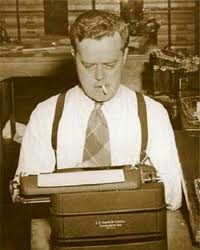
There was a time when journalists and news reporters were heroes…a time when they were huge personalities.  They wrote with panache, shared ideas and commentary that struck a chord with America.  Their ability to turn a phrase captivated us and the masses loved them.  Journalists were the rock stars of the day.  After a while, though, newspapers started to think these writers were getting too big for their britches – bigger than the newspaper brands they wrote for — and decided to turn down the dial.  “If Jimmy Breslin becomes bigger than the Daily News, what happens if he leaves?”

Journalism became antiseptic. Lifeless. It lost a great deal of its humanity. When was the last time you cried after reading a piece in the paper (online or paper paper.)

Blogs to the Rescue.

Enter the blog.  No bosses. No editors. No sponsors.  Just peeps talking to peeps. Readers get the straight shot. Today’s most impressive, unadulterated journalists are bloggers. Ironically, when bloggers get big, big media tries to hire them.  Like punk rockers that have a hard time mixing art and success, this can alter the work product of the blogger.  The Conundrum.  Newspapers are losing money because their writers churn out auto text.  Journalism needs more heroic personalities. That’s what I’m talkin’ about! Peace.

PS.  My favorite journalists?  Nicholas Kristof, Dexter Filkins, Cathy Horyn, Robert Scoble

Nordstrom’s role in Worldwide Inventory.

0

The concept of worldwide inventory, where the web is searched for products and services across different stores and different countries is coming. So is the concept of worldwide pricing.  Need a knee replacement for under US$11,000.  There’s a doc for that.  Anyway, Norstrom’s is taking a step in this direction by allowing shoppers to access inventory from all of its 115 stores.  “That little blue cocktail dress you wanted to buy for the party Tuesday is out of stock?  It’s available in your size in our Atlanta store and can be sent to your office just in time.  Don’t forget to bring a steamer to the office.”

One would think that this service already existed, especially with all the talk about store supply chain management software, but it’s not that common. Nordstrom has found that same store sales are way up since implementing this web-based inventory program. Turns — the rate at which inventory moves — are down, higher spending shoppers are using the stores and because the inventory is moving there’s less need for “sale” pricing which keeps margins up.  Nordstrom had to hire a few more people in their shipping dept. but that cost was offset by the incremental sales. Granted, this is s microcosm of worldwide inventory and worldwide pricing, but we have to start somewhere. Peace!

Mobi-sodes

0

The next big thing will be a video webisodes channel for mobile devices. More and more today, you see people on trains and benches staring down at their mobile phones.  If they are not typing or moving the cursor they’re watching movies.

 Not everyone has time for movies.  You might have 20 minutes of alone time on the way to a museum, club or ballgame. You’re LOLed out and don’t want to bother someone with another inane cell phone conversation starting out with “Hey. What are you doing?”  The answer?  Log on and find some video programming. It will start out as a single curated channel called Mo-Tube or something, containing short length “mobi-sodes” of 16-22 minutes in duration. After a while there will be more channels and programming segments, but it will start with a single new branded channel. Not necessarily serial in nature, these mobi-sodes will be designed to load and stream efficiently and, I’m guessing will be available via subscription.   Aol, you feel me?

New Type of Programming.

This will be a new type of programming – not radio, not TV, not movies.  Just little chunks of original and mashed-up programming that stimulate the viewer, fill some time and get the brain moving. Mobi-sodes. Coming to a device near you…in three years or less.

 PS. I know someone will say the channel exists already, but if a tree falls in a the woods and no one is around….