Marketing

    The new OS.

    0

    Riddle me this. When does an operating system really become an operating system?   When it truly delivers a digital assistant that manages all devices by voice activation. As Amazon’s Alexa intends to do.

    Operating systems today are made up of software that undergirds other software and applications, e.g., iOS, Windows, and Android. In 20 years voice commands that direct “ons,” “offs” and other device and system activations will be the operating systems.  These assistants will compete with each other for supremacy.  There will be systems by Amazon, Apple, Microsoft, Alphabet and one or two start-ups. None will integrate (at first) but mark my words, these are the operating systems of the future. Because they operate real life things…including cars.

    These operating systems will be the battleground of the next 50 years. Will they be free?  Will they be as expensive as cars? Will consumers be paid to use them? Time will tell.

    Peace.


    Strategy Bounty.

    0

    I’m in a hurry this morning. Heading to Orient Point for a ferry to Connecticut then on to see Pearl Jam at Fenway Park in Boston, MA, It’s great being human.  Anyway, I will only post a short one today (as if they aren’t all short.) 

    Apple has decided to offer bug bounties to hackers for any software glitches found in their software. Very contrary to Apple’s position of bug-free software it has been lauding over Microsoft for so many years. Still it’s a good move.  

    I’m going to riff on the idea and ask companies to offer “strategy bounties” to brand planners. I’d love to look at a brand strategy for a company and ID any anomalies for money. Who will my first payor?

    Peace.

    Itty Bitty Data Club.

    0

    So what’s up in marketing strategy these days? Two words: BIG DATA. I’m okay around big data but am much more facile around LITTLE DATA. I use data often in planning: sales, margins, target penetration, adds, moves and deletes but I loves me some little data. Info that  resides between consumers’ ears. What they say they like. What they don’t say they like. What they dislike and why. And, of course, the culture into which products and services fits. This is the softer side of planning.

    My two previous posts were about “proof.” One might think that proof, evidence and tangibles are not the softer side. Sometimes they’re not. But honestly, new unexpected proofs can be found while delving into the softer side. Contrary, market-busting proofs.

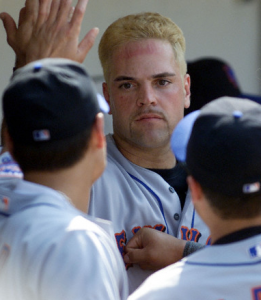
    mike piazza blond

    There was a cultural moment 15 years ago when the Mets Mike Piazza stepped out of the dugout with blond hair — giving permission to 100 million American men to color their hair — effectively doubling the size of the hair color market. That was a softer side or little data proof. Something that could have made a big data woosh had it overcame cultural stasis. It did not happen and here the hair color market sits.

    Don’t overlook the itty bitty data club. As Yogi might have said, it’s big.

    Peace.


    Brand Strategy for Start-ups..

    0

    Yesterday I wrote about the role and importance of mining proof as it relates to creating a brand strategy.  But what does one do if working for a start-up – a company with no past? A company with no product?  Certainly that makes things tougher.

    I’ve been-there-done-that and there always is a past. There is always some kernel of a product or service. In previous posts it’s been mentioned to “follow the patent.” In most start-ups there is a patent or a patent filing paperwork. There must be proof in there. Normal brand planning discovery looks at two things: customer care-abouts and brand good-ats. So for a start-ups, you’ll find it easier to rely on care-abouts. Always a good place to start.

    While the director of marketing at Zude, a start-up in the social computing space, knowing what customers cared about helped form the brand idea which, then, informed product development (noun and verb). The Zude brand strategy claim was “the fastest easiest way to build a web page.” The idea came from the brilliant underlying drag and drop technology. With that as the North Star, everything moving forward became easier. For everyone – even the lawyers.

    Start-ups think of brand but not brand strategy. Pity.

    Peace.


    Residue of Claim.

    0

    In my ongoing effort to define brand planning and share my framework for building strong brands, the word “proof” comes up a lot. No matter what type of brand I study, no matter how many insights rise to the top of the discovery effluvia, proof provides path to a successful strategy. “Proof of what?” you ask. That’s not only the question, it’s the answer.

    pick axe

    As a student of brands, marketing and advertising I’ve decided that 80% of the promotional side of marketing is baseless claim. Generic terms like “reliable,” “great taste,” “low cost,” and “best service” are ported to market by every marketer on the block. Listen to the claims in a pod of TV advertising and the claims are the same from one brand to the next. So consumers shut them down.

    That said, it’s the “proof” of those claim that we hear. The evidence of those claims. Vestiges and residue of the claims is what remains. What is left for the mind to grasp after we’ve told people how great our product or service is.

    PROOF is everything is brand planning. Insights may be the sexy side of planning, but mining and organizing proof toward a brand claim is how you build a brand.

    Peace.


    Content Creation Gone Wrong.

    0

    mass production

    I am a big fan of content creation, the new marketing meme sweeping the nation. Content creation has been around as long as the written word. As a tool to promote and sell it has been around since Bass Ale invented its mark and the Sears Catalog was the Amazon of its day.  But the words “content creation” in this age of Google and iPhone movies has taken on, at least for me, a strong commodity meaning.  A creative-by-the-pound activity measured in attention then, maybe, sales.

    I am a brand planner who measures success not by hits or vague engagement activities but by sales. And future sales. Sure I’ll write a speech on “web accessibility” for an agency trying to score points at a client’s annual marketing meeting, but I don’t want giggles, attaboys and future invitations, I want new customer contracts. Content isn’t oration, it’s selling.

    So the brand planner in me thinks that content creation or content marketing ungoverned by a brand strategy (one claim, three proof planks) is wasted effort. Every act or action that marketing achieves needs to motivate a sale in one way or the other. If you are doing content creation and it doesn’t move a customer closer to a sale, you likely don’t have an articulate brand strategy.

    Peace.         


    Northwell Health Gop.

    1

    I love the North Shore-LIJ Health System, now called Northwell Health. I’ve invested hundreds of hours helping build the brand and business, beginning in 2000 or about. I’ve been met the organizations best and brightest physicians, administrators, and board members and feel a deep kinship with the brand.  My brand strategy for the system, 15 years old now, has worked through 4 ad agencies and even more campaigns. So it pains me when I read these mission words on a website:

    At Northwell Health, we believe every role, every person and every moment matters. We embrace our Culture of C.A.R.E. (Connectedness, Awareness, Respect and Empathy) with our people and the communities we serve and our organization’s values of Caring, Excellence, Innovation and Integrity. This helps us make a powerful and positive impact on our patients’ and customers’ experiences.

    There is nothing wrong with a broad mission or even 4-letter acronyms. That said, I suspect this value statement was written by a new ad agent or copywriting employee with no strategic north star. Anyone with the organization for more than a few years, including CEO Michael Dowling, knows this cookie cutter paragraph is on every hospital website, in one form or another, from here to Abu Dhabi.

    A brand strategy (one claim, 3 proof planks) is the mission statement writ small. A mission statement is an expansion of the brand strategy – but this one is not close to the uniqueness that is Northwell Health. It’s gop. Directionless, rudderless gop. Sorry Northwell. You can do — and have done — much better.

    Peace.


    Memeable Key Phrases.

    0

    Whoever invented the term “keywords” probably worked at Yahoo! in its heyday. Today keywords drive the monstrous SEO/SEM business but are getting out of hand when it comes to bidding wars in the Google-verse.

    One of the things I’ve been focusing on with search for my brand consultancy is the “key phrase.”  The memeable phrase.  (FYI, a unique name such as whatstheidea, is a great brand start.) As a daily blogger and original content creator (Google “Posters versus Pasters”), I know that owning key phrases on Google and pointing them to my site is a great long-term traffic builder. Yes, it may take a while. Yes, I could speed it up with a black hat cowgirl at the controls. But I much prefer the slow, steady build. It feels cleaner. 

    Key words are easy but lazy. Key phrases are rich, targeted and ownable. Think phrases!

    Peace.


    Dispassionate Old Brand Planner.

    0

    That’s me. While every strategist of a non-certain age will tell you how passionate they are, I am happy to report the opposite. I am dispassionate.

    When passion takes over my rigor, when my thoughts get juiced toward an idea, I need to dial it back and continue to be open-minded. It is way easier-said-than-done. But it works. Short cuts are bad in the brand strategy business. They can feed the idea, but one must let the process play out. Dial back the passion until it’s time to cull the idea.

    As for the old, it’s really a state of mind. I’m sixty and to many people that’s old. People look at resume for someone who graduated in the 70s and their right brain takes over. “They must lack energy, are soon to retire, not good with technology.”  Lots of negs.  But from my seat, looking out, I don’t see that at all. Of course, when I go to a Hot Tuna concert, there are a lot of grandparents there. (Hee hee.) From a professional point of view, when I evaluate myself I see a brand planner who has only been practicing for 8 years. Maybe director level.  I see a modestly experienced brand planner with lots of business and life experience.  Maybe a late bloomer. (Prior to brand planning I was an ad agency account  guy.)

    So it has been a reboot for me and I wouldn’t change a thing. I enjoy the f*ck out of what I do. Oops, dial back that passion.

    Peace.


    A little brand self-analysis.

    0

    Were I to conduct discovery on What’s The Idea?, my brand consultancy, and articulate its claim, it would probably be “A powerful brand idea is indelible.”  My email signature and tagline use this statement behind the words “Campaigns Come and go…”

    So that a brand strategy isn’t perceived as a one-trick pony, I employ a proof array comprising 3 support planks. This allows for pluralism in the brand story. This allows for a the claim of brand value and, hopefully, superiority to have multiple dimensions. All of which build the case and brand value. (If the claim and proof array theory isn’t working for you, please email for examples. Steve@WhatsTheIdea.com.)

    I’ve never written a brief for What’s The Idea? Amazing! It probably would be a good thought. Shoemakers children and all that.  So sans brief, what might my three proof planks be for the “indelible” idea?  Let’s think on the fly:  

    1. Indelible means Memorable. Easy for consumers to play back, either in conversation or visual imagery.
    2. Emotional. Something that is near to the heart of the buyer. I refer to care-abouts often in my blogging but an emotional care-about trumps a wan care-about any day.
    3. Optimistic. A plank should be positive – toward the category, the purchaser and the marketing order supporting the commerce. Leave bad news for the media. Good news is branding’s purview.

    There you have it, 3 proof planks for the powerful “indelible” idea. Now, off to work.

    Peace.