Marketing

    Eating Right is Big Business.

    0

    You can tell the vitality of a marketing category by its advertising — and right now the retail grocery business is heating up.  With 17 percent of all US adolescents obese and the likelihood that for the first time in the history of our country children will grow up less healthy than their parents, the retail grocery business is finally beginning to innovate and in the right direction.

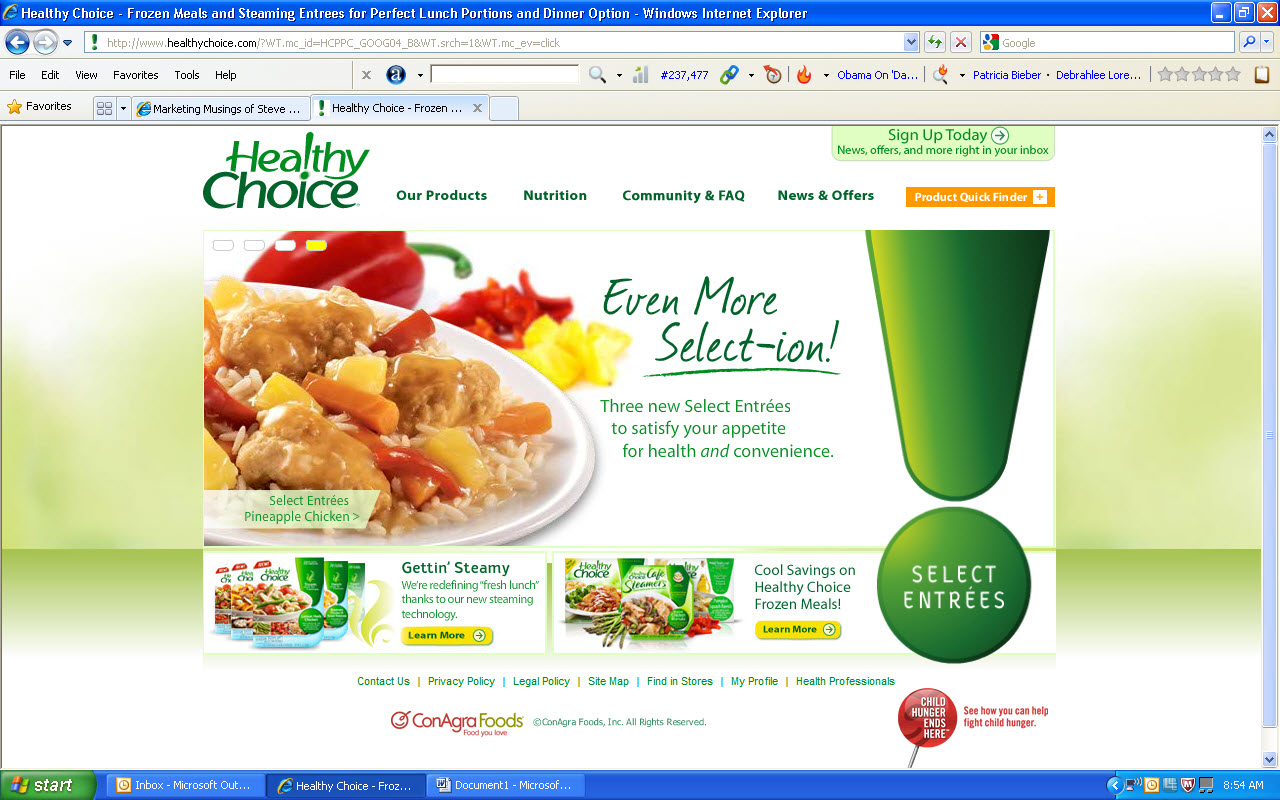
    Thumb through the ads in Progressive Grocer and you will see some with real claims. Real proof.  It’s easy to do good advertising when you have real innovation to sell.  Yeah, yeah there are still some charts and an ad or two with cheesy headlines (Hershey’s “Delivering Innovations Shopping Solutions”), but unlike the ads in a recent copy of CIO Magazine, crafted with stock art by internal market departments, the grocery trades are cranking out work with real stories. And you can tell that the ConAgra’s of the world are excited to be introducing lines of healthy steamed entrees.

    Feeding America more healthy, more affordable food (not usually used in the same sentence) is driving “what’s up” in the grocery business. It may not be a sexy category, like social media, or mobile phones, but it’s important and growing.  And in a few months all this trade advertising will move into the general media markets and feed (sorry) the general advertising business. Exciting!  Peace!

    A Site 4 Next Generation Business Leaders.

    0

    High level departures.  Those of us in the business world are fascinated by them.  Who is being forced out at the Tribune Company?  Which chief software architect is leaving Microsoft?  What CEO is taking fire at one of the world’s largest web portal?  Companies with massive high level departures are seen as damaged companies. And markets move based on this type of intell.

    But what is the opposite of high level departures? Mid-level hires? The hiring of really smart people on their way up? Employees with a bullet, on top of their games, destined to change markets? Yup.  These mid-level executives, very much appreciated by their companies, don’t get celebrated publically. Oh, they want the notoriety but they keep their heads down.  Not blow-hard bloggers, they work their asses off, pay their dues, get smart on everyone else and wait for the payday.  By the time they get noticed in the press, they’ve already made their moves.  The human resources people and head hunters who find these people early on are the real heroes.

    We need a website that caters to this business segment.  It’s a perfect online community: active, aggressive, engaged. But anonymity is a key. Perhaps this community is sponsored by a recruitment company and all posts are anonymous.  Only the site owner can identify the participants. OnTheirWayUp.com?  It’s experiential not narrative…and the perfect place for mid-level over-achievers to get noticed early.  “I yike it,” as my kids used to say. Peace!

    Save a Cup.

    0

    On average, Americans use 159 gallons of water a day – more than 15 times that of the average person in the developing world.  Today is Blog Action Day and the topic is water.  Our overuse of water in America is. embarrassing.  My mother-in-law, who lives in North Carolina, is always talking of droughts.  Our lawn this year was a brown mess by summer’s end, because we chose to limit our watering.  (Our neighbors lawns looked fine.) That said, our upstairs toilet is huge, wasting more water per flush than it needs. Many are aware of their water-wasting and are beginning to do something about it.  In fact, we are legislating change but it’s really not enough.

    Just as I stopped taking brown paper bags and handfuls of napkins from delis years ago, I need to think more about flushing and ablutions and showering.  No brainer. What the future holds in store for us are two kinds of water in America: potable water and non-potable.   Non-potable water will be used to wash clothes, cars, flush toilets and water lawns.  It will probably be recycled water or slightly desalinated from the coast. The good stuff will be for drinking, cooking and brushing teeth. (And hopefully in the preparation of beer.)

    We have lots to do, so let’s start now.  If you’ve ever been really, really thirsty you know how special water is.  Please celebrate it and treat it as precious.  Save a cup today. Peace!

    Microsoft. Harvest or Cut Bait!

    0

    I think it’s time for Microsoft to go into harvest mode.  Harvest is a B- school term that identifies the last part of a company’s lifecycle.  It occurs when companies stop investing and planting seeds and simply harvest what they can while idling down.

    There’s still lots of money to be made on PC operating systems and productivity software, so reap those rewards and stop wasting the profits.  Do it for shareholders.

    What was the last Microsoft product or service that broke new ground?  It seems every new thing they launch has been invented before.  Yesterday’s announcement of the new operation system for mobile phones, Windows Phone 7, was a little bit late to market, no?  Like 2 years late.

    There was a time when Microsoft was the shizz.  Big, powerful, filled with the smartest people in the business.  Sadly, like the punk rock band that became famous, fat and less angry, I fear Microsoft has lost its mojo.  It still has more money than G O D and, so, sustains…plodding along innovating OPS (other people’s stuff).

    Microsoft, is looking through the rear view mirror.  Come on Microsoft, shake it up right now or harvest and move on. Peace!

    PS. Steven Ballmer quote on Windows Phone 7, “We focused in on how real people really want to use phones when they are on the go.”  With this type of thinking how can Microsoft miss? JKJK.

    PPS.  Having done some more homework on MSFT, I’m open to the idea that maybe Window Phone as a mobile OS might actually be a pretty big thing. Maybe there is some bait cutting going on after all.

    Digital Agencies Less Profitable?

    0

    Twitter and Skype just made executive moves at the top in efforts to take their fast growing, oft used businesses in the direction of profitability.  Both companies are moving past their infancy. The venture partners helping drive the strategy of these two exciting, brilliant tech companies are pushing for stronger, more “grown up” management.

    This makes me think about digital marketing shops — other businesses coming out of the infancy stage.  Do big holding companies like IPG, WPP, Omnicom and MDC Partners cut digital companies more slack than traditional marketing companies? My bet is they do.   The young, filled-with-promise always get the benefit of the doubt. Plus, I’m guessing the financial people at the holding companies don’t quite know how to manage profitability of digital clients just yet.  Because digital is the fastest growing sector in marketing, profit blemishes are being masked.

    Digital business people grouse that they don’t get a seat at the big person table when it comes to planning. Often, the “idea” is already cooked when the didge shops are brought in — the big expensive thinking complete.  What is left is the digital translation, a degree of digital creativity and execution… much of which can be performed by lower cost worker bees. If this thesis is correct, then the per capita payroll of a digital shop is lower than that of a full-service ad shop. This is why the profit margins are lower, why digital shops don’t scale past new business, and why they are not getting a seat at the big table. This will change, but will probably lag the pace of change at companies like Twitter and Skype. Peace!

    PS.  RGA does not fit into this mold. They have strong highly paid talent throughout. They are the exception.

    Aol, Yahoo and the Devil that is Advertising.

    0

    It’s Advertising Week In NYC and Aol has launched a campaign (Product? Movement?) it hopes will make it more relevant.  I love their idea to have an idea. 

    Aol’s declaimed strategy is to become a content leader on the web. Easily said. This campaign suggests they are serious.  Loosely called ProjectDevil, it is based on an insight that one-third of the web is advertising.  And poorly curated advertising at that.   A print ad in The New York Times today shows a side-by-side comparison of an old school website and a new school website.  Old is covered in ads and links, while new is elegant, clean and surprisingly magazine like.

    If you go to the ProjectDevil site, which has been nicely cobbled together and targeted to an advertising audience, you get the sense that Aol is spending money, currying favor with smart digital people (a bit of a pander) and focusing on the presentation of content.  Compared to Yahoo, its closest competitor in the “content strategy’ strategy, this is a refreshing first down.

    The “one third insight’ is a strong one.  The content strategy is a strong one.  If Aol gets better content and innovates with the delivery of that content, next year at Advertising Week you’ll see a very different company. Peace.

    PS.  Last year I was walking around Advertising Week talking to Yahoo people who were oblivious to the awful Ogilvy work passing them by on the sides of buses.  Within weeks the account had moved to Goody Silverstein and Gareth Kay.  Yahoo is with a good shop, but their idea is still percolating.

    T-Mobile’s Brand Redirect.

    0

    T-Mobile has made a very smart marketing move by offering kids ride free on the family plan.  In our house, mom pays the phone bills for all family members so T-Mobile has done its homework when it comes to the whole decision maker buying experience.  

    What’s smart about the promotion is that most plans now offer unlimited texting at a flat fee and since kids only text, this is win-back play of some marketing magnitude.  In print ads, T-Mobile compares their $59.99 plan for 5 lines to AT&T’s $59.99 Family Plan for 2 lines (mom and dad). 

    T-Mobile, who still has the nicest brand color palette on the market, has locked up the phrase “The Family Network” with its logo in print advertising in NY, yet the website still publishes “Stick Together” as the corporate line. I smell a bit of desperation amidst this new kids-for-free tactic. No doubt, the new idea is working and kids do grow into loyal adults if well-treated, but flip-flopping brand strategy and taglines is scary stuff. 

    I’d like for T-Mobile to stick around; it’s good for competition. And carving out a space as the “family” network is quite doable, but it will take more than one price promotion and some cutting and pasting. It’s going to take a massive plan. Peace it up (in the Middle East)!

    Ear buds as noise cancellers.

    0

    I don’ know about you but I can’t read on the train if there’s someone nearby shouting into their cell phone.  Hate to admit it but I can’t concentrate if there are people sitting on that same train yapping at a certain decibel level. How about trying to read at the beach next to someone with a loud radio? Am I alone?

    Enter video on NYC subways. This is half a good idea.  As an ad person, I like the medium and its ability to provide meaning sponsored entertainment and information. As a reader I don’t like it because it’s going to be more than a nuisance. 15 years ago, everyone read on the subway.  Yesterday and this morning everyone had ear buds. Later today and tomorrow, with Kindles at $139 and other tablets ready to land, many will be reading again.  But with the new advertising and programming din on subway cars (now available on NYC’s Number 7 line) it may be difficult. And are other commuter trains be far behind?


    Plastics.  That’s the answer. Soft, sanitized, polymers that fit into the ear. Once reserved to combat snoring and chatty jury rooms, ear plugs are a business with mad upside. You laugh.  Mark my words. Peace!

    A Small Business Business Idea.

    0

    Though I don’t completely understand what goes on behind the walls of the Dachis Group in Austin, TX, I’m a big fan of their consulting practice and pursuit of Social Business Design.  Having lived in the space contiguous to the one they’re trying to reinvent — creating more effective businesses through improved web 2.0 collaboration – I like how they have outlined the category and believe their Social Business Design terminology will stick. Like ERP.

    They have money, are willing to spend it, and have a client list to die for.

    Peter Kim, an early group member, wrote a post talking about the speed with which some companies are implementing social business change.  Much of the work his company does is with large enterprises but large enterprises are like battleships when it comes to new stuff.  I wonder if the Dachis Group might speed up adoption of its services by serving early adopter small and mid-size businesses – the first to rebound in an economic recovery.  Talk about the need to do more with less.  A small business practice at Dachis might also help inform the enterprise group and cover more of the business ecosystem.  A thought. Peace!

    Network TV Needs Recombination.

    0

    My favorite modern marketer and lexicographer, Faris Yakob, uses the word “recombinant” a lot in his work and it’s a word I love.  His thesis is that everything is old and that what is new is just repackaging and/or a recombination of existing borrowed things.  

    The new network television schedule launching tonight reminds me of Mr. Yakob’s theory.  More cop shows, medical shows, a sitcom or two depicting likeable middle ‘mericans.  But nothing really innovative.  The last innovation, if you don’t count cable using the word “dick” was probably reality TV, now accounting for 2 out of every 10 shows. Program-wise everything is so stale. Oh, we can text message and affect outcomes, but that’s a little 4th grade don’t you think?

    We need some recombination here.  Mix a little Steven Colbert with 60 Minutes or NFL Pregame with America’s Most Wanted.  How about recombining House with Jersey Shore. Better yet, why doesn’t network TV go beyond recombination and just innovate completely.  The answer I trust lies somewhere at the nexus of consumer generated video, geolocation, gaming with a dash of celebrity.   The next big thing is out there and programmers with the vision to break the mold will reap the rewards. Come on networks, hire Mr. Yakob for a month.  Peace!