Marketing

    TV is back, baby.

    0

    There’s a big media conference in NYC this week and attendees and reporters are surprised to learn that TV viewership is growing. One conference attendee said:

     “TV is, by estimates, still gaining share of the overall advertising market, to 40.7% in 2010, from 37 % in 2005.”

     Another chimed in, “TV will be adding about half of all growth next year.”

     The web ad market is growing for shizzle, but the 30 second spot is not dead (Joseph Jaffe).  In fact, the Super Bowl is kind of off the charts. Another conference attendee suggested TV is growing because of the need for viewers to have something to Tweet about or post on their Facebook pages. Yah think?

     The fact is, TV programming is just getting better. The networks are working harder for our eyeballs. The Emmy bookcases at CBS, NBC, ABC, FOX are not growing as they once did thanks to cable properties such as Sons of Anarchy, Breaking Bad, Mad Men, Chelsea Handler, Men of a Certain Age, etc. The big networks are beginning to pay attention — feeling the fire. As Eddie Vedder might say “It’s evolution baby.”  Weed out the weak genes in favor of the strong.  Won’t be long now and reality TV will start to secede from the union. Peace!

    Manual Labor. New School.

    0

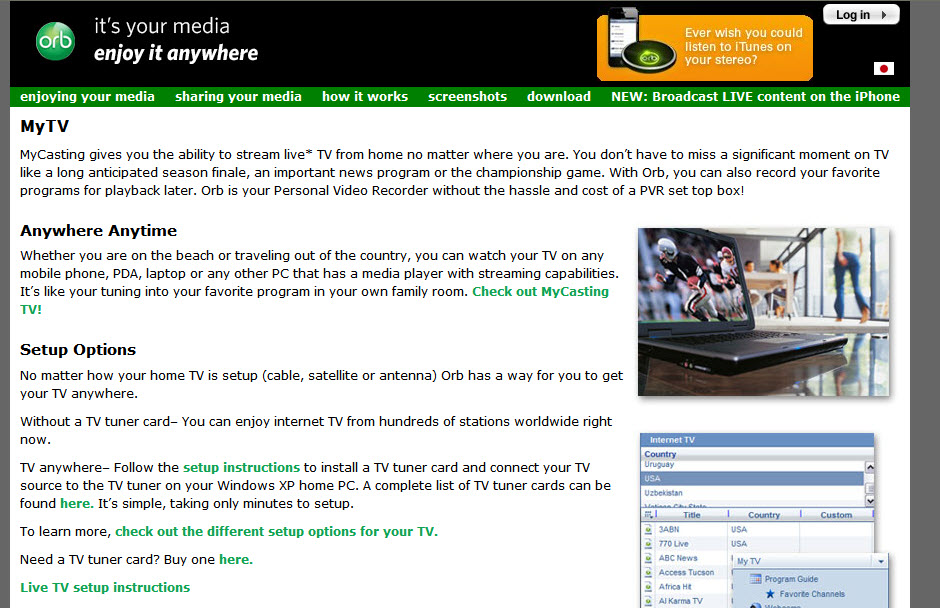
    Here’s a marketing practice we might be seeing a lot more — new products shipping without manuals.  The new Orb, a TV recording device written up by David Pogue in The New York Times today, does not come with directions. Pogue lambasts the company for this because the Orb requires a fairly complicated set up. He said the Orb is not ready for primetime but tres cool, by the way.

    This “no manual” approach wasn’t an omission, it was a smart tactic – one that insures new customers must visit the website.   

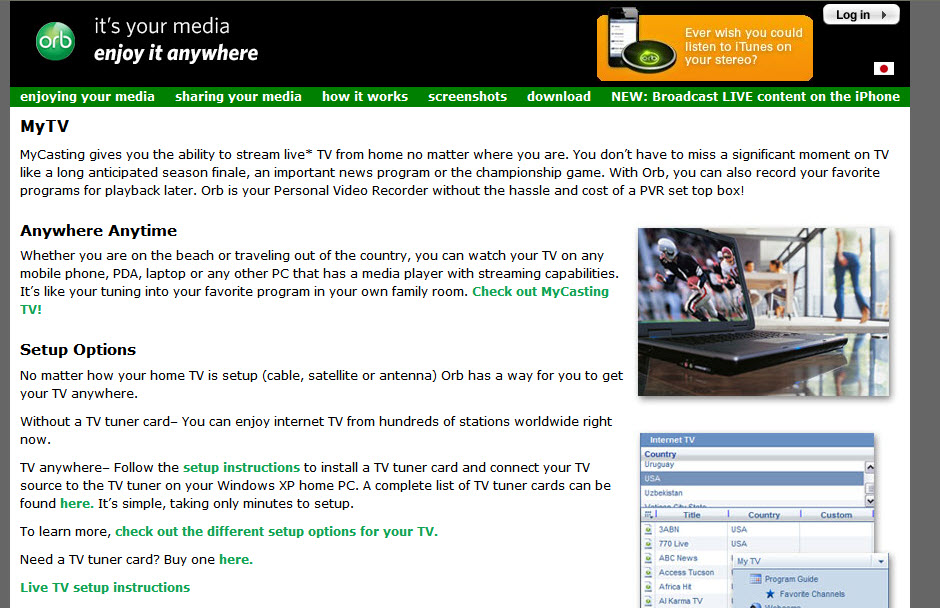
    It’s a sustainable practice, which is forward-looking, unless you print out 50 single sheets of paper from your HP Laserjet, and it offers up some significant marketing surround.  Though the Orb people haven’t executed it well (see screen grab of homepage below), this OOB (out of box) experience, makes buyers visit the website where it can continue the selling process and provide a video set-up tute (That’s short for tutorial, Bronwen). It’s a great place to get an email address and product registration info and also a chance to cross- or up-sell – an especially important step for ecommerce customers who may not have had an opportunity to speak with a salesperson.


    No manual. I yike it!  Peace.

    Google and Groupon. Big Nice!

    0

    The intro to The New York Times article today on the impending purchase of Groupon by Google says the motivation for their move is to “dominate” local online advertising and improve its play in social networking.  These two things may be results but, for me, they are byproducts.  Google never set out to be an advertising company, it was born of search. Search and arithmetic are its lifeblood. Like farmers hundreds of years ago who were good at farming then became king, search is what made Google a powerhouse.

    That’s why I liked the purchase of YouTube. Google made is easy to search for video. This is why I like the move on Groupon. Talk about apps?  Couponing is a zillion dollar marketing application — and if Google sets it sights on making couponing more effective and efficient, it will completely change that market.

    You may have read here before about Google’s “culture of technological obesity” and how that culture has driven the company to offer productivity software (work processing, spreadsheet, etc.), a mobile phone, an new OS and and and. These efforts have been off- piste (Is it snowing yet?) and the reason Google will trivest in less than a decade.  So I’m not a Google fanboy — but they deserve much respect for this move.  This is mad max stuff.  Now, stay away from my television until you are ready to provide a truly useable search product and we’re good. Peace!

    The Web’s Specialty.

    0

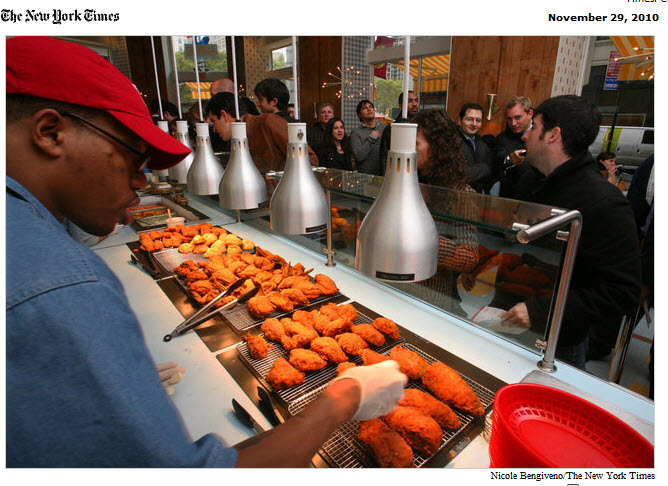
    There’s a cool story in today’s New York Times about single-food restaurants. It stands to reason that enterprises of this type can only thrive if the food is excellent and the stores located in highly populated areas.  In NYC you can take out and, in some cases, eat in at a Mac and Cheese store or a meatball store. There are places that sell only mussels, only rice pudding, and only fried chicken. It’s a growing phenomenon. Specialization suggests focus; a focus on quality, ingredients, product and knowledge.

    In mid-town Manhattan, where there are probably a half million lunches served within walking distance of any high-rise, there are lots of options. So why not go to the best option; the place that specializes? The place that eats, breathe and sleeps its specialty. Forget me not that this type of store can scale well and have a supply chain with amazingly fat margin opportunities. That’s gravy at the gravy store.

    This is a key chapter in the story of the Web — and where the web is going.

    I’ve written before about “worldwide pricing” and the ability to search the world for the best prices.  Well, how about searching the world for the best quality? The ability to do so is a web app. And specialization and focus are the tools of that trade.

    We are bound by product and service mediocrity because of geographic and time limitations. And because of supply and demand.  Well, say buh-bye to these barriers.  Ima stop there and let you entrepreneurs ponder that for a while. Ponder, Ponder.  Peace!

    Coupons pollute the social stream.

    0


    In the future, Groupon will be a powerhouse. (Right now it’s a power hose.)  

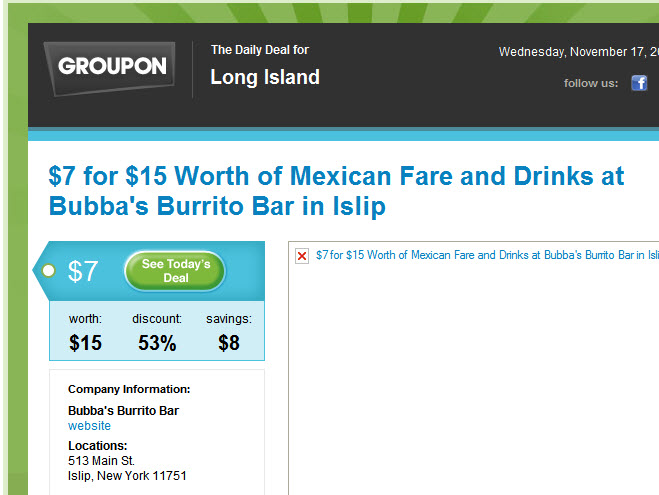
    My first email from Groupon arrived yesterday promoting Bubba’s Burrito Bar in not too far away Islip, NY.  Bubba’s offered me $7 off a purchase of $15.  I clicked through but the link was broken.  Stoked, because I’d been to Bubba’s and liked it very much, I wrote them a note about the link faux pas certainly will visit them soon, coupon or not.

    Today, Groupon emailed me a promotion for America Apparel.  Not exactly, where I shop. It’s email number two and already I see an email unsub in my future. So why with this targeting problem do I still expect Groupon to be a winner? 

    Focus.

    Groupon has some things to work out but the idea to encourage “group” promotions and group referral by geography is smart…and gaining traction.  Plus this is the right economy to be in the coupon business.  I gripe often that marketers are tainting social media by tossing coupons around Facebook and Twitter, etc. It’s too much. Groupon has the potential to be a cure for this boorish behavior. Coupons need to be sequestered but easily found — they do not need to be all over my social media stream. Period.

    If Groupon focuses solely on coupons and coupon users, they will evolve; especially if they pioneer the application of the social graph (relationship mapping of social friends) with coupon use and geo-targeting. Groupon will win this category because of focus.  And because couponing does not belong in the waters of the social stream. Peace!

    A Sign of Economic Life.

    0

    It’s been a couple of years since Bernie Madoff pounded the NYC elite, making off with their summer homes — and until now, you could feel it in the pages of The New York Times.  Lots of ads disappeared. Then more ads. And finally more ads.  There was a big reduction in luxury goods advertising and the pages of the Times were no longer filled with Avedon-type photographs of beautiful men and women dressed and accoutered to die for.  Photos and ads were under-produced and unbecoming. Well, the ads in the Times are coming back — in number and refinement. And though some promise 30 and 40% off, advertisers are beginning to pump it up.

    I know, I know, it’s almost holiday season but you can smell change in the luxury goods market. Could it be the leadership shuffle in Washington and the wishful thinking of the tax-burdened?  Or has the string of Bernie been salved over?  How about the quarterly reports from retirement accounts reclaiming lost ground? Yes, yes and yes.  I’m no economist and I’m certainly not counting truck drivers in the truck stops along the highway, but at least in The New York Times the pages are beginning to show a bit more smile.  Peace.

    Loving Wal-Mart’s Free Shipping.

    0

    “I love free shipping” was my wife’s response when I mentioned Wal-Mart’s newest offer on all website purchases this holiday season. 

    eCommerce is propping up the shipping business (US Postal Service, UPS and FedEx) and dinging the oil business.  Some economics student should plot U.S. online sales increases growth to barrels of oil consumed as a thesis topic.  When a consumer says “I love __________ (fill in the blank)” you need to pay attention. The wifus loves free shipping and she loves free returns – especially so, when the return label is already in the box. 

    This is how the return thing works: Outside in the garage is a second refrigerator.  On top of the fridge, spilling off in all directions, are boxes. The boxes are a few steps closer to the kitchen than the car.  To return a product, she walks to the garage, grabs a box and some Amazon bubble bags or newspaper, then returns to the kitchen where she assembles the box, labels it, grabs the packing tape out of the cupboard in the butler’s pantry – zip, zip and to the front door.  If it’s UPS or FedEx she may have to dial a telephone number or click-to-pick. Could that be any easier?  Easier than say, driving to a store, standing in line and doing the whole credit card thing?  

    This “I love free shipping” behavior, even as a trial at Wal-Mart may, as The New York Times declares, deliver a “knock-out punch.”  Not to Amazon, but to a number of smaller retailers with inelastic margins who can’t play this game.  Oh, it’s here to stay. So watch out.

    eCommerce makes every day Christmas day (insert your holiday here).  In store shopping, for its many positives, has more than its share of negatives; especially around the holidays. Wal-Mart is paying attention. What a marketing juggernaut. Peace!

    BBH’s Vaseline Intensive Rescue Work.

    0

    Unilever has launched a Vaseline Intensive Rescue campaign via Bartle Bogle Hegarty, NY.  It was conceived in a conference room, formed and nurtured through social media, and produced by a CPG company and ad agency. Excuse the pun, but BBH never uses a rough hand in its work so I’m surprised by what I’ve seen and read so far.

    According to a write-up in today’s NYT, BBH employed a web monitoring company to scour blogs and social networks for women with dry hands.  Smartly, they were looking for Posters rather than Pasters and found three who like to blog about mommy stuff and seem web-o-genic. But then they trotted out camera crews, writers, producers etc., in an effort to create “authentic” spokesperson stories. I smell 15 minutes (of fame).

    Social media campaigns works best when the spokesperson is not managed.  When they are real.  Melting Mama, for instance, is an example of a Poster who is real.  Kandee Johnson, make-up artist, is real.  These two have personal motivations that makes them compelling. Not a motivation, seeded, tilled and fertilized by a marketing engine.  BBH is better than this. It feels B team and formulaic. This is no “Prescribe the Nation” campaign – BBH’s brilliant work for Vaseline Clinical Therapy in 2008-9.  That was an idea with ballast. Peace!

    Me too. Three, Four, Five.

    0

    Twitter owned real time updates. Facebook mirrored it. AOL owned chat. Facebook copied it. Google owned search.  Facebook morphed it.  Foursquare developed check-ins.  Facebook parroted it. And Groupon owned coupon search. Facebook Places has mimicked it. 

    I worked at a social media start-up (Zude) for a tech savant who wanted to out-YouTube YouTube, out-DoubleClick DoubleClick and out-MySpace MySpace. What he had – what we had – was the “fastest, easiest way to build and manage a website,” supported by a unique drag-and-drop technology.  Sadly, the CTO didn’t want to perfect usability, rather, he wanted to be the best at everything. Hence, we were the best at nothing. 

    I’ve written about Google and its “culture of technological obesity” and it seems Facebook now is sharing that affliction.  You can’t be everything to everybody.  Do something well, stick to it, prefect it, then evolve it. But don’t keep stealing other people’s cheese.

    The more Facebook moves toward the middle of “all” web functionality the more overweight it becomes. My advice: Focus…and let other companies play too. Peace!

    Derivatives in Marketing

    0

    I’m not sure I know what derivatives are in financial markets, but I sure know what they are in marketing…and there are two kinds: derivative creative and derivative context.  

    Derivative creative feels like an idea stolen. When you see or hear the idea, you think of another brand.  That’s bad. When an idea has a conscience tied to one brand, you must stay away.  Hack creatives make a living on this type of stuff. It smells like something bad in the fridge.

    Then there is derivative context.  This is smart creative.  It’s not as smart as something absolutely clean and un-owned, but it is smart nonetheless and doesn’t require bazillions to seed the idea with consumers. It’s smart because the idea comes pregnant with meaning the marketer doesn’t need to build.  If I say “Hot Tomato” is sounds like “Hot Potato” and contextualized makes one think of something too hot to hold.  (Okay, bad example, but it’s early in the morning.)

    Derivative creative bad. Derivative context good. Next! Peace.