
Lens of Strategy.

0

Here’s an interesting brand planning question. 

“How complicated is your brand?”  I’ll bet 8 out of 10 C-level execs would answer “Not very complicated at all.” 

“We are a network of doctors.

We sell interactive white boards to schools.

We are an ad agency.

We are a tool used to build websites.

We are a consulting company.”

These uncomplicated answers typically focus on the Is of the Is-Does.  The question begs for simple answers. And it asks the C-level to pass judgment.  No one except for coders and surgeons likes to celebrate complexity.

Yet when I get into marketing departments and do a little deep dive, complexity always rears its head.  It is where we get into the Does of the Is-Does.  What the product does for consumers. Rationally and emotionally. We look at targets and segments. Most valued customers. Highest sales customers. Biggest referring custies. We break out the Excel charts. And because marketing is not just about making brochures and ads (though some would argue otherwise), we focus on product experience and price and line extensions and the pulsing of the bank account.

Brands are complicated without a plan. With a plan, not so much. With a plan we look at the complicated things through a lens of strategy. Always through the lens.

So, back to the original question. How does a brand go from “It’s not very complicated” to a mish mash of tactics, spreadsheets, sales reports, channel problems and lax sales. Poor planning. Peace!
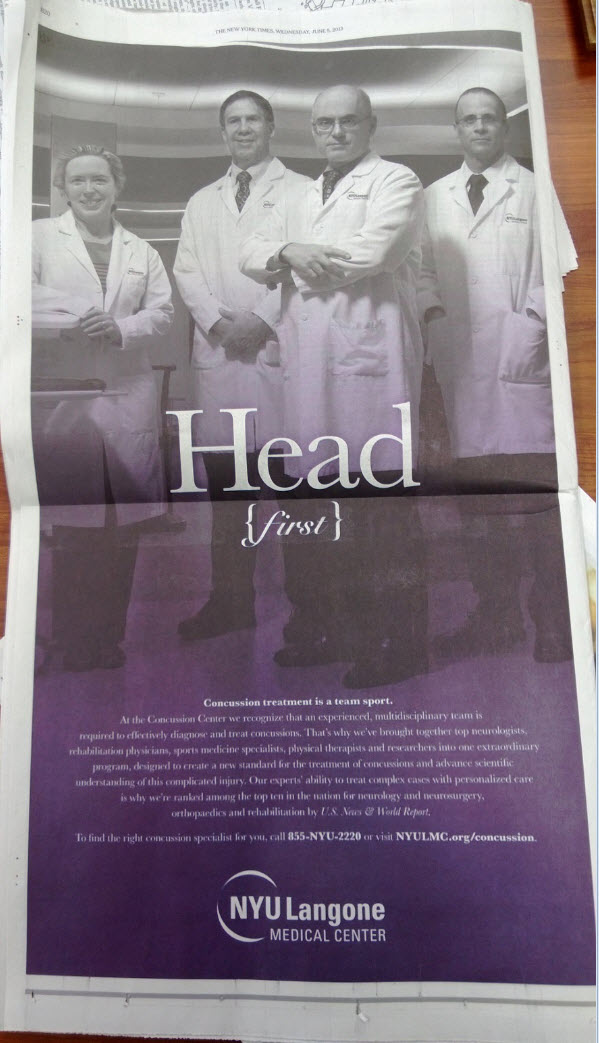

Purple ads.

0

langone edit

Growing up in the ad business and knowing how hard it is to do well, I often harp on poorly conceived advertising. Especially that of the print variety.  This adverting is done by a good mid-sized agency in New York City, but either the planner or the creative director doesn’t care because week in and week out the execution – the whole campaign, in fact – is just sad. The hospital likes the ads I’ve heard, so at the agency the only one digging this work must be the CFO.

A great litmus for an ad is the idea.  The idea as played back a day after it has been seen.  This ad is “one of those purple hospital ads.”  “The ones with the one word headline.”

I read this ad stem to stern as I have many of the others in the campaign and still haven’t a clue as to the strategy. Or what the brand stands for.

If you spend enough money, people will see your ads. It you buy the right media people will see your ads. If you don’t have an idea, people will see your ads. They just won’t be able to form an opinion about you – other than you have enough money to advertise. You have a name. And in this case, you like the unique color purple. Peace!

PS. I’m sure the women and men at NYU Langone are terrific and save lots of lives. I applaud you, but it’s time to find a brand and brand idea.  


Brand Plan as Immune System.

0

immune system

Always on the lookout for metaphors that help marketers understand branding, I’ve come upon a new one: the immune system.  When a marketing entity has a brand plan (defined in my practice as one claim and three support planks) it has created an immune system designed to deflect all non-essential forces. Maintaining a healthy immune system takes work. It must be cared for and fed.  If the immune system has to work overtime, because the brand is constantly being attacked by outside forces, or it is spending time on off-plan activities, it weakens the immune system.

And let us not forget the immune system is a system. It is not separate unrelated functions or activities. Brand planks, discrete parts of the value proposition working together to increase brand meaning and loyalty, are not always organically aligned. Too much price message might negatively impact the quality message, say. Too much focus on tasty, may impact the healthy message.  Each brand needs its own balance because every brand is different.  But the quick story here is that “a tight, focused organizing principle for product, product experience and messaging” can create an impervious barrier for your brand to ward off evil.  

What are the parts of your brand’s immune system? Peace.   

Brand Therapy.

0

Is your brand a little scatterbrained?  Does it sometime feel like it lacks direction? Do your brand managers like to keep busy – sometimes just for busy’s sake?  Maybe you brand need a little therapy.

How does one go about getting brand therapy? Well, you need to go to a professional. You might ask “But can’t I do this myself?”  The answer is no. Just like you can’t do your own appendectomy. Some parents can’t see their kids for who they are.  A momma rarely thinks her baby is funny looking. It’s hard to heal thyself when it comes to brands.  You are too close and too invested.

The tools a professional uses and the tools an informed brand manager or CMO uses will often be the same: research, data, demographics, psychographics, competitive analysis, listening, and concept testing.  But it’s what one does with all that information that is therapeutic.  Deciding what must be discarded and what must be kept in the brand plan. What to give away vs. what to cultivate and grow.  This is what will come up in brand therapy and what will drive the client to key realizations. It is the client that has to make the tough decisions. The client that will self-actualize the brand. The therapist facilitates and lays out the issues, but the client makes the decisions.  The process is therapeutic, painful and healthy. 

I wonder why more companies don’t do it.  Brand therapy makes for healthier brands and healthier brand manager. Peace!

Moment of Proof.

0

The two most important elements in marketing are claim and proof.  It’s how you build businesses. Simplified and organized, this claim and proof approach is the foundation of branding.  One claim, three support or proof planks.

One of my kids just graduated college and is on the interview circuit. Loaded for bear, somewhat unfettered, he believes a willingness to work hard, learn and focus on achievement are the qualities that will land him a job. He’s not wrong. But these things sound like your average cover letter. When shared face-to-face over a desk, they are a bit numbing.  My suggestion was “don’t forget the proof.”  Follow up each claim with examples. 

This is what marketers often forget.  More often than not marketers and their agents remove proof so they can shoehorn in more claims. It’s claim-apalooza out there. All theater, exposition, and context – no proof.

When a job seeker organizes what s/he wants the interviewer to know about themselves and sells it with stories about real event it can be indelible.  Same with brand building. When the dude jumped out of the capsule up in space and free-fell to earth while drinking Red Bull (JKJK), he evinced an energy rush second to none. 10 million media impressions be damned. That was a powerful moment of proof. Peace.

One Mis-Direction

0

Office Depot, according to Stuart Elliott the ad writer for The New York Times, will be conducting an anti-bullying, back to school campaign this summer, using a boy band called One Design (or some such, JKJK). The grab-all idea is: “Live. Love. More” — as in “Live kind. Love everyone. Move together against bullying.” I’m not into 3 word taglines or ideas and the ones that require 8 more words to explain are even more perplaxing but I do love causes. Unfortunately, using causes as a way to break through with your advertising is a fairly common mistake.  They are easy to talk about, easy to surround with quotes, advocates and a powerful narrative. Often though, they are off the brand plan and only slightly tethered to sales — if at all. Plus they are kind of transparent.

That said, bullying is bad so let’s hope this campaign works. The creative idea is a montage too far. It’s almost ad-silly. The idea would be best boiled down to “Live Kind.”  I don’t think Lance would mind (not Lance Stephenson).  You see, if you “live kind,” then you probably try to love all and shun bullying. Live kind is memorable. Familiar, yet unique. It’s also a baby step, not the whole enchilada.  

This campaign is more for parents then kids, I get it. And like aroma therapy, it may provide a nice glow for the brand.  Were I the brand manager, however, I’d do this through the PR group and use my ad dollars to de-position Wal-Mart, Office Max and Amazon.  With a kick-ass, 360 retail effort – trotting out some mobile and twitch point planning tricks. Peace.  

White space.

0

There seems to be a trend in TV programs these days, especially heady police drama imports where directors use a good deal of white space during dialogue.  If a :60 radio spot contains, say, 120 words then a 47 minute TV drama probably contains a 3500 words of dialogue. Some of these new white space shows are quite powerful because of camera work, performance and real acting. What is left unsaid and anticipated can drive the viewing experience.

When it comes to marketing and advertising, there is very little white space.  White space is usually left to the art director – who becomes the only artist (ar-teest) in the room. Everyone else is piling on.  Strategists should be preservers of whitespace.  No unnecessary noise in the message to cover up the key selling points. Brand managers, too, can learn a thing about the power of white space. 

That which we do not say, allows what we do say to have more ballast.

White space.  Tink about it (as my Norwegian aunt Inga might have said.) Peace.

Frank’s Red Hot Sauce Radio Spots.

0

One of my favorite advertising campaigns is for Frank’s RedHot Sauce.  It may be my only favorite ad campaign.  I heard if yesterday morning and had to remark about it to the lady at Ace Hardware.  The business strategy is to get consumers to put Frank’s RedHot Sauce on more dishes.  I use hot sauce on burritos and tacos only.  My brother in law from North Carolina likes it on his eggs.  (It’s not bad.) The more dishes Frank’s can get you to spice up with hot sauce the more sales it rings.

Now normally funny advertising for the sake of funny is not something I advocate.  Funny is rarely a brand plank. But the little old lady with the graggy voice who performs these spots is quite the star. But the copywriter is the true star.  Each ad repeats the line “I put that shit on everything.” Of course the word shit is beeped out. The bleeped word is the hero of the spot. Try not laughing. Try not understanding the strategy. Try not visualizing a little old lady putting hot sauce on her breakfast, lunch and dinner.

Some church people will be offended. Some parents with small children will have to explain to their kids why they are laughing. Some will want to protest.  Me?  I just love that ____.  The best ad campaign I’ve heard in a long time. Peace. 

A Twitch Point Planning Example.

0

Readers have heard me speak of a marketing convention called Twitch Point Planning, a rigor which helps planners “undertand, map and manipulate consumers closer to a sale.” Twitch Point Planning is an outgrowth of today’s, multi-channel, always on media devices.  Today I was reading the NYT and came across an article about George Orwell and the town Katha in Myanmar where he wrote his first novel “Burmese Days.”   Before I had finished the article, I’d powered up the Kindle, logged on the new office WIFI password, and downloaded the book for $2.99.  That’s a Twitch and the newspaper story was a Twitch Point.

Now, had I only been half interested in George Orwell, or Burma, or Myanmar I may not have transacted business.  So what might sellers of this book put in my way, elsewhere, to move me closer to a sale?  That’s the $64,000 question.  Thinking about that, is thinking as a Twitch Point planner.

moors google maps

What will emerge from this model? Well, if the NYT shared it topics and content with the public in real time, or perhaps the day before publishing, Twitch Point Planners would know what searchable terms, pictures, Google maps, images might be worthy of content or advertising attachment.  When Fred Wilson (of  AVC.com) was reading the bio autobiography of Keith Richards on a device and fired up Google Earth to see what moors really looked like, that was a twitch (and possible place for a tourist ad). As more Twitch Point Planning exampled come up, I will share. Unless you beat me to it. Peace

Plastic Home Pages.

0

I recently had a big argument with a company in transition. They were known for one thing, with 75% of revenue tied to that thing. Problem was, their future was tied to the other 25%.  I was told “Get the old thing off the home page. Fill it with the new thing.” That was the easy part.  The hard part was I was instructed to “Create different doors for different kinds of customers.”  I argued “For a company in transition, without a lot of awareness and mindshare, the home page needs to deliver the brand strategy.”  Home pages that don’t convey brand strategy are often montages of pictures, products and navigation. They lack a POV. A heart.  Home pages are the one place in the online world where marketers have complete control of their brands. They can control the story, the claim and the proof.  The 3 door approach would have evicerated the strategy.

Why do so many company make brochures out of the home page real estate? Brochure tables of contents, really.  Homepages are more and more important in marketing today and they are the least attended to.

For new or unknown companies the home page must communicate the Is-Does. For mature brands, it must move customers emotionally and rationally closer to a sale. Not closer to another page. Templates suck at this. Plants and trees that stay the same are either plastic, hibernating or dead. Your home page should be none of these. Peace.