Marketing

    Web Videos.

    0

    There are a couple of different types of videos that marketers put on their websites. Product demonstrations are a common type.  They typically provide an overview of a product’s Is-Does after which they show how to use the product. Sometimes they fall into the tutorial category.  How to properly press coffee, how to use a new mobile application, how to clean your shower grout. 

    Another type of web video is educational. It uses visual narrative to help consumers learn more about a product or category so as to make them seem like an authority — and as an authority deserving of special purchase consideration.  Category leaders, the saying goes, educate the market.  

    A third type of website video is the infotainment or sales-otainment video. They look good on paper, read and view well on storyboard, and often look beautiful as a finished edited product.  The problem with some of these sales-otainment videos is they are nothing more than a script, a giggle, a product shot and invoice.  Like “we’re here” advertising that does no more than state a product name and where to purchase, these sales-otainment videos are all over the place. The goal of many of these efforts is to “go viral.”  (Wrong goal.)  Big ad agencies are doing them.  Recent film school grads are doing them. High school friends brothers are doing them.  

    There is comedy writing and acting. There is directing and producing. There is invoicing and remittance.  But let’s not forget that web videos have to sell. Of course they have to be interesting, but that alone will not work. If research doesn’t indicate predisposition to buy more product after having seen a sales-otainment video, it has failed. Sales-otainment videos need an idea. A selling idea.  Peace!

    Humor.

    0

    I have a presentation on Fast Twitch Media and Twitch Point Planning that asks the question are our brains evolving bigger or smaller?  Larger, posited Timothy White back in the 80s when I asked a question about evolution during a John’s Hopkins symposium, but I’m not so sure.

    As software takes over decision making for us, it seems we have to think less. That is, unless we’re deciding which GPS to use — the Garmin or the Android phone app. (They are not perfectly in synch! Oh my.)

    One of the things coders and engineers cannot do very well is humor.  It’s not that they are genetically indisposed to humor, but humor can’t be programmed. There is no algorithm. And therein lies the value of the creative mind.  

    Humor is a wonderful tool in society and well valued in content creation that surrounds marketing.  I still giggle each time the BBDO/ATT “flash mob gone wrong” ad appears, though it is wearing out. Humor gets noticed and it disarms.  It is an elixir that helps a sales message get consumed. Branded utility is the rage these days in mobile apps, but soon that utility will become commoditized and we will need to smile as we tweak our media and our apps.  Might as well begin now; add a spoonful of humor to your digital selling and see what happens. Peace!

    Watch to Learn.

    0

    There is something to be said for the ability to observe consumers.  Interviewing is a great and not over-rated technique but consumers don’t always tell the truth. Good interviewers get to the truth directly or indirectly but observation of  behavior doesn’t lie.

    I was thinking about this and the bank category the other day.  How does one create a great brand plan, then marketing plan for a bank?  On Long Island, over the last couple of years a lot of car dealerships have been torn down.  Oddly, the lots upon which they sat now house banks. More banks?  How to differentiate?  I wondered if I were to sit in a bank and observe for a couple of days what I would learn. If a poker player can see tells, why can’t brand planner?  

    I would watch the eyes of customers as they enter. Watch their hands. Note expressions. As they spoke to bank reps are they falsely smiling and nervous? Do they look at the clock a lot. Check their cell phones too much. Are they emotional? Proud? Deflated?  When they talk about certain subjects do they tick?  Rub their hands together? Look away? You get the picture. Pairing the behavior with the topic would be quite telling. And provide strong fodder for marketing design.

    While with a web start-up that boasted no initial desire for formal usability testing (don’t get me started) I did it myself.  Fascinating. Just watching how Millennials navigated around the pages to learn the apps was invaluable. I was able to articulate three types of first user experience (FUE) behavior. Could the users have explained it to me? Doubt it.  My cultural anthropology teachers and Margaret Mead were right. Observation is a special, special information gathering tool. Peace!

    A note to Sherwin-Williams.

    0

    One of the fun things about being a marketing consultant is helping companies come up with new products.  Today most call this practice innovation.  I have a new R&D idea for Sherwin-Williams or really any paint manufacturer.  Design a clear coat finish for external house paint that when spayed on in a light mist will add years to the life of the product, improve color retention and prevent mold.   I’m no scientist, but one would think a breathable (or not) resin applied over a new coat of paint that helped extend the life of the finish would be something most home owners would invest in. Especially if priced correctly. 

    The product would add to the total ticket price of the average house paint sale. Sherwin-Williams could even sell or rent the spray machine for an added revenue opportunity.  And as a new product category, this sealer/finisher would grow the total market.  “Add 5 years to the life of your paint job for only $99.”

    I love growing markets and categories.  Now, if I could only just get a hair color company to make it cool for men to color their hair…

    Are there ways to repackage and add to your product offering?  Give it some thought. Peace.

    Google, One Step Closer to Trivestiture

    0

    In February of last year I predicted Google would split into 3 companies.  With its intent to purchase Motorola Mobility, announced this morning, Google is one step closer.  The point of my original prediction post was lost in favor of a searchable sound bite reposted by Steve Rubel: “Google’s culture of technological obesity” but that trivestiture angle may now take on some weight.

    This is a very big move for Google and will continue to blur the lines between hard and soft ware companies no doubt with an expected response from “Guess who?” Microsoft. (Look for a potential full purchase of Nokia within the year.) Mobile is so hinky and malleable right now I think the Android/Moto thing will work. And then open may be out the door — guess we’ll see.

    For all the tech prognosticators this announcement will create some serious buzz and take eyes off of Google+, a half-baked though still tasty cake.

    Como se wow!  September should be an interesting month. Peace! 

    Claim and Proof in Brand Planning.

    0

    I’m reading the book Disruption by Jean-Marie Dru — it’s about time, I know – which was a pretty famous advertising thought piece back in the 90s. Even creative directors referred to it and they’re not ones to readily admit being inspired by other CDs. Live ones that is.

    And Mr. Dru talks about two elements of an ad: the idea and the execution. The idea is the demonstration of the product value and the execution is the creative surround. So for Charmin bath tissue, said Mr. Dru, the idea was “squeezably soft” and Mr. Whipple was the execution.  

    Brand planning for me follows this route for the most part, though I use words “claim” and “proof.”  The claim is the “idea” and the proof is the “execution.”  But in my world the execution is very organized.  Organized by selling schema in the form of three brand planks.  For a commercial maintenance company I wrote a brand brief that likened the company to the Navy Seals of maintenance. The planks were Preemptive, Fast and Fastidious.  When the client presented the company online, in brochure, ad or in person, the presentation was always cloaked in one of these three principles.  The company prevents problems through forethought, is absolutely quick to react, and precise and fastidious about every job.  Like a Navy Seal. This is a coda employees need to live by and one that customers find easy to grasp and hold on to. 

    In branding, Claim and proof, well thought out, works every time.  That’s disruption! Peace!

    AOL Not Yet Filling the Void.

    0

    There is strategy and there is execution.  A great strategy poorly executed pays naught. I like AOL’s “content is king” strategy; buying the Huffington Post and TechCrunch were nice blockbuster moves.  There are two ways for these purchases to go: either the properties will be enhanced by AOL and grow or they’ll be hindered and slide.  At the high end, these two purchases are defining moments and should be very interesting to follow.

    But let’s look at the lower or middle tier. AOL now needs to find some traffic-building Posters (original content creators) on their way up.  Not those owning killer numbers, but those with killer points of view and motivations with big upside.  Sports teams make a living off of young over-performers who are killing it before their first big contract. Up and comers are what AOL needs. Some of whom may not even be Posters yet.   

    Finding potential big time Posters is R&D in the web content world.  AOL needs to research what people like online, then find and/or develop the property.  Content is not writing. It’s not reporting.  It’s not curating or aggregating. These are content tactics.  The best Posters (who attract the all-important Pasters) are people with an idea, a passion, a motivation or a love. They are also sharers.  AOL is buying media properties and traffic and that’s a good start, albeit a bit old school.  It now needs to do some R&D and find ideas that fill voids. In markets and brains.  Peace!

    Feets Don’t Fail Under Armour Now.

    0

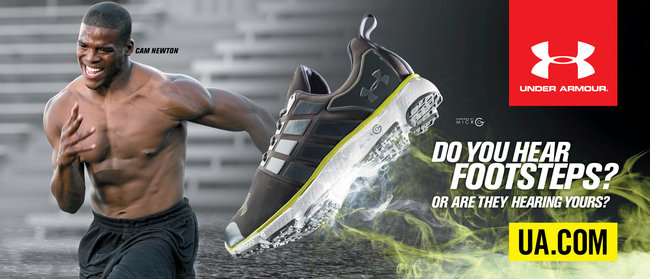
    Under Armour is introducing two new sneaker designs (May I call them sneakers?) this week in an attempt to increase its share of the $22B athletic footwear (sneakers) market.  A market, by the way, that was only about $3B in 1993.  The TV campaign handled by Twofifteen McCann and Digiteria for digital offers a lot of smart tactics: the director of Friday Night Lights, a YouTube takeover to reach the younger buyers, limited distribution to build demand, Cam Newton, and an idea that ties sneakers to sports action – FootstepsAs smart as these tactics are, they feel like a pastiche of forced-together marketing tools from an Effie Awards Annual. I suspect they will work, however.

    First and foremost though, one must ask if footwear is a business Under Armour wants to be in.  I say no. And I’ve said so before in WTI.  Sunglasses? No as well. UA founder Kevin Plank, in his heart knows this.  He owns a franchise that is now being diluting.  You can’t keep sticking the same tea bag in new water.  The company already owns fast twitch muscle, form fitting wicking shirts but will lose that ownership as it takes its eyes off the ball. Wicking sneaker tops?  Not so sexy.  Lindsey Vonn. Oh yeah.

    Mr. Plank’s next move should be into form fitting shorts and shirts for the fashion conscious market.  Leave the kicks to Nike.  Or start a new footwear endemic company  This is one brand extension that might sell some shoes near term, but is going to turn Under Armour into a brand in decline overall.  And it’s sad.  Stop playing with feet! Peace.

    (Picture from NY Times.)

    Levi’s Has Lost its Rugged Way.

    0

    I love a good cause.  Clean water, sans parasites , in the developing world (Africa) is one such. Levi’s jeans, as part of its “Go Forth” campaign, is sponsoring a Facebook program that ask people to click their support for Water.org, and once a 100,000 clicks are gathered Levi’s will donate money.   This is “good’s work” (thank you Bailey’s Café) and it will make a difference. I support it and suggesteth everyone go forth and donate. That said, Levi’s still needs a brand idea and “individualism and independence” ain’t it.


    If Levi’s cares about the environment, and I know it does, they should jump on the durability wagon.  Buy one pair, don’t get one free, you don’t have to buy another pair for 3 more years.  That’s environmentalism.  And stop with all the stone washing stuff that wears the jeans out a year early.  The worn-in patina of a pair of Levi’s is the badge.  Faded knees, faded pockets, holes in the crotch.  This is life. Not art imitating life.  Don’t pay some schmekel to pre- tear your jeans…get up on the life cycle and wear them out yourself!

    Levi’s is one of the great American brands and it has lost its way.  FCB got it.  BBH got it a bit and sexed it up. Wieden and Kennedy, a brilliant shop, has found a core, but it’s the wrong core.  Individualism and independence a brand plank, not “the idea.” 

    The Water.org project should be left to the PR dept.  Fight the durability fight (it’s American) and get mad credit for the environment – on so many levels. Peace!


    Fear…meet anger.

    0

    NYC’s Mayor Bloomberg is doing something really noble, it was reported today. He is spending some of his personal foundation money to help black and Latino male youths stay away from jail and become more employable and more employed.  Total dollars spent will be $130 million. If handled well, it will improve the quality of life of this group of young men who index high for lives of crime, becoming baby daddies but not husbands, jail time and recidivism.

    I’ve read about a number of the program tactics and many are well thought out. Morning remedial classes and skills training tied to afternoon paid internships. Re-training 500 probation officers. 900 paid mentors. Yoga for anger management. Computer skills classes. Lots of tactics, but no strategy.  I’m not feeling a “see something, say something.”

    Before Mr. Bloomberg gets out the checkbook and feeds the tactics mill he needs to get the strategy right.  The young men who are most at risk are angry.  Besides their anger sometimes all they have is pride or false pride.  Not being a good reader or student does not create a prideful environment for a man walking into a classroom.

    Fear also surrounds this class of young men.  The fear they create in outsiders. The fear these young men instill in each other which is coin of the realm. The fear of losing control when trying to climb out…or of appearing to sell out.

    Before the first million is spend on this important program, behavioral planners need to understand the fear and the anger. Really understand it.  With that understanding, working with brand planners they need to craft a strategy. Don’t hire Jay-Z. Don’t offer up Amare. Find a strategy that works on the street.  Not above it. Peace!