Marketing

    Brand Names

    0

    Naming is perhaps the most interesting part of branding; especially so, for products that are new, unique and first-mover in a category. Naming that communicates a product’s Is-Does is optimal.  It explains what a product Is and what it Does.  The first light beer, Miller Lite, is a beer and does provide a lighter product profile.

    Brand names with marks, called logos, are able to convey more than just a brand because a picture and/or type treatment offer additional information.

    When a product or service is more complicated, as is often the case in technology or healthcare, the brand name and logo may not be able to convey a full Is-Does. So a tagline offers a fuller opportunity to complete the Is-Does. There are even some cases when all three don’t fully explain — so one completes the story with boiler plate. Boiler plate is found on PR releases and on web sites under the About tab.

    Finally, the best brand names of all offer more than what a brand is and what it does, they offer a little bit of poetry.  A smidgen of humanity and tone.  A smile. 

    Brands are empty vessels into which we pour meaning. Start off with a name that conveys good information and meaning and the pour becomes a little easier. Peace!


    A Creative Tipping Point.

    0

    There’s an interesting article in The New York Times today on the growth and viability of programmatic ad exchanges – algorithm based, bidding based systems that finely tune ads to consumer behavior.  A buyer of hiking boots might be found on a bowling site, for instance, rather than a bird watching site at a more effective price and click-through, so implies the analysis.

    It’s science folks. 

    Anyway, if online media is getting more predictive, tied to behaviors and data trails, then it stands to reason creative will follow. Here’s a prediction: advertising production is going to flip in the coming years.   The big TV shops from holding companies will have fewer creatives than will be found at didge shops.  Makers of shorty, bursty digital ads have long been seen as less glamorous than those who create high production videos and network :30s and that may not change.  But banners and towers and leaderboard and whatever is next will become more creative and effective – it’s evolution baby. And the need for more units, especially those tailored to the algorithm’s finding, will generate exponential leaps in the need for creative resources at digital shops.  Creative will never be algo based, though it will be tried. So the jobs won’t be replaced by the machine — not here. 

    The tipping point for when creatives at digital shops outnumber those at the BBDOs, Ogilvys and Greys is coming.  I bet it will happen by 2016. Peace. 


    http://www.nytimes.com/2012/11/16/business/media/automated-bidding-systems-test-old-ways-of-selling-ads.html?adxnnl=1&adxnnlx=1353068830-60ilVThvwJh1tC+hjCjt9A&_r=0

    Coke Journey and Facebook Envy.

    0

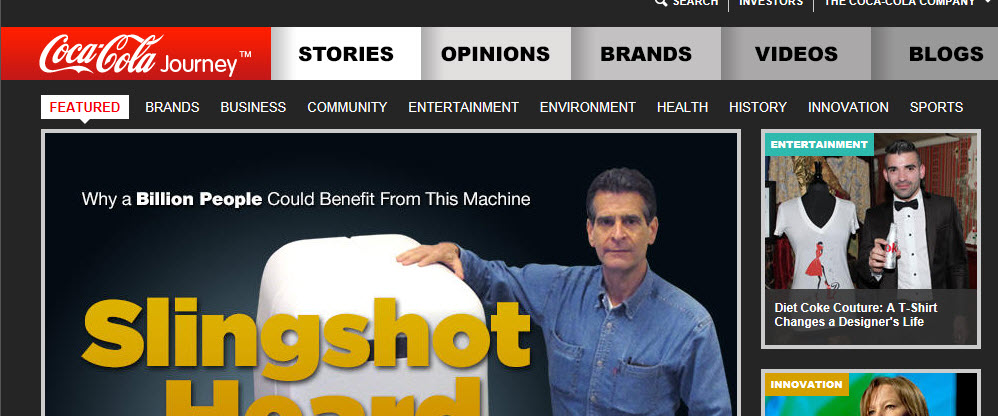
    The Coca-Cola Corporation marketing story is simple but has many layers. The latest layer is the Coca-Cola Journey — a website built to engage, entertain and build loyalty among the family of Coca-Cola brand drinkers and enthusiasts. It’s a corporate website so you can find Minute Maid orange juice, Sprite and other family members represented. Coke learned through its Facebook experience that if it could dally with drinkers and they dallied back – the result would be nice lifts in traffic and presumably consumption. So Coke now fancies itself in the content business. Ding dong, Bud TV anyone?  A business goal, one might surmise, would be to draw users back from Facebook to the new Coke Journey site. Normally, I would applaud this activity, but not if it is going to change the business. Not if it promotes non-endemic brand experiences and cross-product ones at that.

    You might say Coke is using only 5 or 6 full-time employees as content creators/curators – so how does that change the business?  I say these 5 or 6 may have large reach. And a few altered cells in the DNA can be a problem.

    Were I running this show, I’d continue to host sites for each unique brand. I’d add the full-time content creators to each site, but make the content specific to each brand promise. Have them support the “motivation” behind each promise. If AOL and Yahoo! can’t get content creation to run on all cylinders, why would Coke be able to? This is another story of Facebook envy. Mr. Tripodi, I think you went a little bit off-piste with this journey. Peace.   

    A Brand Test for CEOs.

    0

    Here’s one way to see if your company has a brand plan.  Summon department leaders and one random dept. employee into the conference room on a Monday morning. Ask each of them to create a PPT presentation describing the company mission in twelve pages — no more, no less. Make sure they explain what the company Is and what the company Does. (Here referred to as the Is-Does.)  Ask them to report back by 1 P.M., where sandwiches will be served and the work reviewed as a group.

    As with any research, offer up that there are no right or wrong answers and grades will not be issued. 

    Companies with strong brand cultures will share presentations containing similar organizational structure and language.  The other 92% will be a mash-up. What will they mash up?  Learnings from category-leading brands. Things they recall reading in the trade press and news.  A little bit of personal aspiration, maybe some lyrics from the company PR boiler plate and, likely, some CEO language. A doggy’s dinner as Fred Poppe might have said.

    In companies with tight brand plans, every employee knows what business they’re in. They can articulate what products are sold, what customers care about and the business-winning goals. These are business fundies. This is strategy.  It’s worth sharing with employees.  

    Try this brand plan test out and see what can be learned about from a few simple PPT sides. Peace.

    Post-election Ramble.

    0

    (As if all my posts aren’t rambles. Hee hee.) 

    The election is over.  The polemic and political bullshit should be put to rest for a while and the economy is moving in the right direction.   The craft economy has been growing the last couple of years during these very harsh financial times, affected a cultural change. What is the craft economy? It’s a mindset where people take pride cooking for their family rather than paying others to do so. It’s fixing gutters rather than hiring contractors. Knitting sweaters just to see what hand-made looks like. Putting less by the curb and refurbishing the old stuff. Some of this is influenced by the sustainability movement. As the country gets older demographically, roots become more important. We all get waste is bad.

    As for the business economy, companies have cut to the bone; felt the bone, tendons and muscle. Sure companies have made some retrenchment mistakes, e.g., replace marketing blocking and tackling with low cost social marketing, free interns and search engine advertising.  But that’s settling down. The cottage industries that have grown up around social and digital are shaking out and will continue to be important (for other reasons) yet will shrink and make corporate marketing performance stronger.

    With 35+% of the country impacted by Sandy (Can we please rename this piece-of-shit storm something other than “Superstorm Sandy?”  What are we 4th graders?), the masses have learned how blessed we really are for all the creature comforts we have—for what it means to be a neighbor.  When George, the cranky old German guy next door, turns into a huffing and puffing 84 year old in need, we are seeing life more selflessly.

    Lastly, the country’s new-found focus on education, especially that of the K12 variety an exciting new technology overlay, will inch us away from poverty and toward a flatter country. These four things are a good perfect storm.

    These are the words of the typist.  Now go in PEACE!    

    Chest deep and sunny.

    0

    It was a little bit like the TV show Revolution out here this last week – without the pre-blackout flashbacks. Blackouts are still all over the south shore of LI, including my mom’s place in Bay Shore. No electricity is not non-trivial but it feels so when compared to salt water that pervades everything by the water’s edge.  If you live next door to a home with its carpet still tacked down you can smell/feel it. And though the sun has shined for 3 days there is dampness that just won’t go away.

    The “vill,” as I like to call Babylon, has come together like a dookie. People in and out of the America Legion Hall have been cooking, cleaning, meals-on-wheels-ing, and volunteering like nothing I’ve seen before.  Clothes are stacked to the rafters.  And I’ve not even been to First Pres. or St. Joseph, where good’s work is also 24/7.

    Mobile devices are helping save the day, but so are old school signs, hand painted and tacked to telephone poles. These signs, for some, are the only way people are learning of services. Many are still sitting on wet couches, on wet carpets, without power, waiting for the piles of wood, construction bags and furniture to recede, so they can ask for help…almost embarrassed to take an egg sandwich, from the many cars driving by. “We’re okay, go help someone else,” they say. I’ve been brought to tears, for no and every reason.

    Never have I been prouder to live in Babylon. Every day is a new day. Every face a neighbor. And what is that on that blip on the weather map?  That forecast for tomorrow? A mosquito?  Keep your furniture high and your friends and neighbors higher.  (Not a pot reference. How dare you?!)  

    Peace. Vote.
    Closed for business.

    0

    Due to Hurricane Sandy, Whats the Idea? will be down for a bit.  We are safe. Peace!

    Square pegs?

    0

    My sister recently did some consulting work for a small, quick serve restaurant in the Southwest. I’m not going to go into it very deeply – trade secrets you know — but suffice it to say that one of the partners in this little venture is a tad high strung …when he’s not low strung. He handles the kitchen and the customers seem to like him.

    So, the restaurant ran out of potato salad and what does Mr. High/Low do?  Does he say, “Sorry we’re out?” Nope. Does he send someone out the back door to Restaurant Depot for a bucket?  Nope.  He looks around the kitchen, finds a baking potato, throws it in the microwave, mashes it with a fork, adds celery, mayo, whatever, and bam — instant potato salad. Now I have no idea what this little side dish tasted like, and if it sucked bad on him, but you have got to like the creativity and initiative. The fact that he ran out of the salad to begin with says something, but so does the solution.

    Everyone has strengths and everyone has weaknesses.  It’s what we do with them that goes in the ledger.  If Mr. High/Low is allowed to put his creativity as a cook into the restaurant without having to do the things he’s may not be well equipped for, it’s probably a win.  Can some of this creativity find itself into other parts of the business, that’s something worth paying attention to.

    People, just like brands, are most likely to succeed if allowed to play to their strengths. Figuring this stuff out is the fun of business.  Peace.   

    The Pedagogy of Marketing.

    0

    Here’s what marketers can learn from teachers…good teachers, that is.  Much selling these days, especially of the B2B variety, is done via PowerPoint. On average, it is done in 18 slides, anywhere from 12-60 words per slide, one or two pictures – and a flow that would make music bed blush. That’s how marketers and salespeople roll.

    Teachers on the other hand, face a room filled with 22+ kids, all of whom have different IQs, learning styles and attention levels.  Good teachers assess the entire room of kids and create learning experiences to meet all of their needs. Poor teachers teach to the middle, to the median.

    What marketers can learn from good teachers is sensitivity to the individuals, not the median audience. Using that sensitivity, born of bi-directional interaction, they can provide instructive, discovery-based selling scenarios. Make everyone in the audience feel smart, by allowing them to deduce and conclude. (And I’m not talking about the “solution selling” pop marketing approach of last decade, “Tell me about your pain points”.)

    Ads can’t really take this individualized approach; they have to work for the whole classroom. That said, Brits do good job in this area with their ad craft. Everything is not served up rote.  Selling requires some brain work.

    Now, I wonder what teachers can learn from marketers. Hmmm. Peace.


    Joe Tripodi. Man about brands.

    0

    One of my pet peeves is category experience. In the marketing and advertising businesses, it’s everything. Recently, I lost a consulting opportunity because of not having enough financial experience. It was true. Hiring lore suggests: When you come to a position with your head filled with numbers, trends and category milestones, you are a quick study. This approach creates comfortable hiring. (An aside: Do you know how many people take credit for MasterCard’s “Priceless” campaign?)

    Personally, I am most energized when in a new category — being scared, facing a blank piece of paper. Tabula rasa. No preconceptions. Childlike discovery moments all around. Surrounded by fresh language, sights and sounds.  Like being in a new country.

    One of today’s marketing heavyweights, Joe Tripodi, is a category surfer. That’s why he is so strong.  His career trail meanders: IBM, MasterCard, Mobil Oil, Bank of NY, Seagrams Wine and Spirits, All-State, and currently the CMO of Coca-Cola. Whoever hired Mr. Tipodi recognized that his light shines in the area of marketing not technology or banking.

    Good brand and account planners achieve because they see things through fresh eyes. Great hiring agents approach hiring similarly.  Be great when hiring. Peace.