Brand Strategy Built On Quicksand.

0

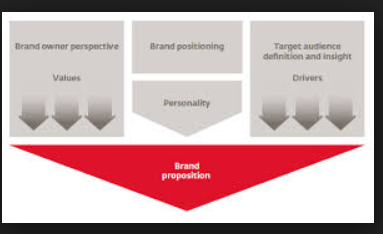
Brand strategy frameworks are a dime a dozen.  All of them are right…to a degree.  This framework, I was told, is from Interbrand.

The brand proposition at the bottom (in red) is also known as the brand idea or claim. As for the stuff above the claim, there’s nothing wrong there — it’s typical brief fodder.  

Interbrand attempts to codify brand strategy across the enterprise, but each office does have some leeway as to its approach. Deviations are allowed because not every brand is in the same place in its lifecycle. Not all targets are the same. Channels are different.  There are a multitude of reasons to tweak a framework, not the least of which is to sell work. I suspect this is the case at many brand consultancies. 

This brand placemat or one-pager is just too freakin’ broad. The proposition, as it should be, is the operative strategy. But there is just so much other stuff going on. 

At What’s The Idea? the framework is brain dead simple. And it is the same for every client. It comprises one claim, three proof planks. A claim is a claim.  Where we differ is that my feeder boxes aren’t values and personality, positions and drivers — they’re proof arrays.  Organized reasons to remember the claim. Reasons to believe. Reasons to argue. Proof creates muscle memory for consumers.

Leave the values/personality/target insights to the art directors and writers. Brand building is an upstream practice that precedes the build out.  If your brand strategy isn’t built upon proof, you are playing in quicksand.

Peace.


Content Marketing Cons.

0

Business-to-business (B2B) brands have spawned a new type of marketing today, one growing by leaps and bounds. It’s called content marketing. Before it earned its current name, this was simply advertising and promotional material, e.g., brochures and fulfillment pieces. It was a big business, fueling ad agencies, trade publications and printing companies.

But content marketing today is very different.  It is primarily words in the ether. Fodder for search engines. Manufactured schema for driving sales though copy and to a lesser extent pictures and video. A new class of B2B content marketing shops have opened up around the country churning out real writing on topics ranging from agriculture to zoology. Gone are the days where you could bury your keywords on a page (white words on a white background) and raise your search profile. And you can’t just copy and paste other people’s copy onto your site to build search ballast. Google has caught on.

Today B2B marketers are employing “by-the-pound” content farms. Farms filled with ex-trade publication writers, retired professors, tyro English majors and other so-called subject matter experts (SMEs).  The problem is, they don’t work for the companies they represent. They don’t get the brand strategy. It’s original content, yes, which Google applauds, but it’s “Choice” content not “Prime” content. And it’s driven by the algorithm, not the brand.

The best content is homegrown. Prime content gets noticed and shared. It gets commented on and argued. If you can’t write about your own company, if you have to hire mercenaries, you are feeding Google but diminishing your brand.

Peace.


Brand Strategy and Messaging.

0

Component three of the organizing principle that is brand strategy is messaging: What a brand or company says about itself. It starts with the Is-Does (what a brand IS and what a brand DOES), extends through employee communications and finishes with outside communications, such things as PR and advertising.

Messaging is the component easiest to understand, yet hardest to corral.

I worked for a company Teq that sold interactive whiteboards to K12 schools. They also offered professional development to help teachers use the technology. The company had about 250 people. On LinkedIn, some employees said they worked in education. Others said they worked for a software company. Some said computers and hardware. 

Messaging starts at home.

Zude, a startup I worked with in the social networking space, was even worse. The chief technology officer, built new features into the product weekly, which took it down unique and different functionality paths. (Google “Fruit Cocktail Effect” with quote marks.) Fail.

Imaging bringing up a puppy, changing its name every week. Like that.

The beauty of a brand strategy is it handles the Is-Does and sets the ground work for all messaging. Whether you are talking or typing about your brand you are either on or off brand message.

One claim three proof planks sets the brand strategy. Simple to understand, simple to follow.  

Peace.


Brand Experience.

0

The second component of brand strategy is brand experience. I leaned about brand experience from Starfish in NYC.  At the time, the company was head by Megan Kent and David Kessler.  Mr. Kessler is still at the helm. Ms. Kent is sharing the branding love at the Go Lab, in Brooklyn.

The What’s The Idea? brand framework, built around “claim and proof,” feeds brand experience.  Using yesterday’s brand strategy example “the navy seals of commercial maintenance” with proof plank of “fastidious,” you can begin to see how to build a branded customer experience. Commercial maintenance companies are not known for being fastidiousness. 

But what exactly is brand experience? Well, it comprises things like retail environment. How one experiences the brand at the store. Starfish’s work for Dunkin’ Donuts years ago, was a tour de force in retail brand experience. It entails experience out of the box. Who has ever opened an Apple product and not said “ah.” Who has not opened a can of Coke and not recoiled from the fizz of refreshment.  And experience is reflected on the website. Who gets you to the world’s information faster than Google?  Fast load. No extraneous content. A lone search bar.  And, who teases a body into the outdoors better than Marmot? Web experience is crucial in brand building. An opportunity lost if not adhering to the claim and proof array.

Brands that organize their product, experience and messaging always know what they are doing. And why.

Tomorrow messaging.

Peace.


The Importance of Product In Brand Strategy.

0

Yesterday I posted a definition of brand strategy: An organizing principle for product, experience and messaging. “Product” is the first component of brand strategy. It seems like a no-brainer but can be overlooked.

Most companies aren’t thinking about brand strategy when developing a new product.  They are looking for differentiation and successful position in the marketplace.  Or price advantage.

Brand strategists do most of their work on existing products; products with established manufacturing consistency and formulary, e.g. Coca-Cola, In-N-Out Burger. Where an organizing principle comes in handy is in cases of line extensions and reformulations.  White Castle, wouldn’t want to create a cat head size burger, for instance.

Where an organizing principle for an existing company most comes in handy is in the service sector — where the product is people.  Sure you can dress them up in a uniform but if you don’t organize how they work and deliver service, it’s harder to brand.

One of my favorite brand strategies in the service sector was for a commercial maintenance company. Their business is cleaning buildings at night and tending the grounds by day. Their brand staretgy became “The navy seals of commercial maintenance” (the claim), supported by “fast,” “fastidious” and “preemptive” (the proof planks). Think these employees didn’t know how to work? Or get a raise?

Tomorrow Experience. 


Brand Strategy Definition.

0

Everybody in America can define the word “brand.” The Kardashians have made the definition more diffuse but still the word has amazing recognition.  Add the word “strategy” behind brand and it makes the task a little harder. Yet people know what the word strategy means so everyone should be able follow semantically.  Honestly though, the big honkin’ problem with the brand strategy business is very few people can actually articulate a process or framework for brand strategy. A means by which or protocol for enacting one, that is. 

This is akin to people in the advertising business being good at creating ad and not good at selling product – the ultimate goal of advertising.

There are a lot of smart people in brand planning, don’t get me wrong.  But most are paid by ad agencies to provide and insight or two to tickle the creative department.  And those who are employed by branding firms (e.g., Interbrand, Landor) are, in the main, armies of mid-managers paid to enhance presentations of names, logos, color palettes and experiential effluvia. Brand craft is more like the ad business (present stuff) than about the strategy.

Starting at the beginning, a proper definition of brand strategy is “An organizing principle for product, experience and messaging.”  If your organizing principle is not organized, meaning it’s too broad or hard to articulate, it’s not an organizing principle.

Tomorrow, a look at “product,” the first of the troika of brand strategy components.

Peace.


Gap and Old Navy Divorce.

0

Gap and Old Navy have decided to spilt up.  Gap, with sales down 5%, will keep a number of portfolio brands and Old Navy, more of a value brand whose sales are up, will land on its own.  Explanations for the split suggest Old Navy and Gap customers don’t really overlap and store operations are a bit different – so it’s a good split.

From a branding standpoint, I like the idea. Retail brands staying with the Gap include Banana Republic, Athleta, Intermix and Hill City.  Old Navy is reported to be “a little more fast-fashion, more quick, lower price point,” according to Greg Portell of consulting firm A.T Kearney. That makes Old Navy a good $9B standalone company.

When looking at the care-abouts and good-ats of each brand (Gap and Old Navy), you are likely to uncover competitive advantages, unflattering to the other. And while I’m religious about building positive brand value, playing off of a competitor’s negatives is fair. When both brands are under one roof, management does not allow insinuations or pot shots, which can inhibit brandcraft.

So the gloves will come off. Gap continues to have work to do. Old Navy better double down. Let’s go!

Peace.


Branding. Where To Start.

0

I am flagged as someone who answers questions about branding on Quora. Most questions are from tyro branders.  “How important is brand marketing? How can I promote a Balsami rice in a local market?  When an interesting question comes up, I jump. I love furthering the science of brand strategy.  It’s a most human science.

The first thing I tell everyone is: Branding begins with the product. A good product will sell. A bad product will not repeat sell. An average product may sell. Everything about branding starts with the product.  Songs, color, ad budgets, and market share do not build a brand. Good products, promoted in an organized way, do.

Just as amino acids are the building blocks of protein and muscle, brand strategy provides building blocks for successful brands.  Finding a product’s best features and most desired features is the brand strategist’s way forward. If you can’t find the best, most desired features, you are working on a bad product.  Fix the product. Period. Re-cut the bait. Find new bait. Don’t mess with a bad product.

Peace.


Benzer Pharmacy. Brand With a Difference.

0

A pharmacy is a pharmacy, right?  A prescription at CVS is the same as Walgreens, is the same as Rite-Aid. Duane Reade, a venerable NYC brand, sells the same meds as the next girl. Duane Reade, built its marketing around its NYC roots but unless they sell hot dogs with red onions in the store, it’s not much more than an advertising play. Pluck the ethnocentric heart strings. So how would a brand planner build a unique pharmacy brand. 

Enter Benzer Pharmacy, a regional player with national aspirations, headquartered in Tampa, FL. What they say in copy is what other pharmacies say. From the website: “Be The Best Healthcare Provider For The Families We Serve.”  

But here’s what they do: Free home delivery, deliveries to hospitals so patients have meds before discharge, provide education on meds making sure patients have much needed understanding, and they provide a service that maximizes drug and cost effectiveness.

Everybody wants to offer the best care. Few prove it.  Proof in a commodity business is where brands are built.

Benzer Pharmacy gets product marketing. Therefore, they get branding. Next step, create a brand strategy and take on the world.

Peace.


Show Don’t Tell.

0

There is an old maxim in advertising and marketing that “showing is better that telling.”  I was in a meeting with a technology group at AT&T Business Communications Services a while back. We were there to set strategy with a group who had not done any real advertising before. Our intent was to validate our understanding, the objectives, and the strategies prior to putting pen to paper and mouse to screen.  After lots of PPT slides, the client asked us when we were going to get to the part where Darrin Stephens (ad guy from Bewitched, a TV show) stands up and shows the boards with words and pictures on them. He clearly wanted to be shown not told.

My brand strategy presentation is unique in that it’s 85% show. I use real brand strategies (names redacted) from past clients so clients have examples. Not theoretical explanations.  I can tell you 20 times that a brand strategy is an “organizing principle for product, experience and messaging.” I can explain the framework as a “one claim and three proof planks,” but when I show people and explain how the values fit, everyone gets it.

In advertising, people approve briefs, but they really want to approve the ads. In branding, they sit through the marko-babble and brand-babble, but really want to see logos, taglines and designs. Show don’t tell.

If you’d like to see examples of real brand strategies in your category, please email Steve@WhatsTheIdea.com.

Peace.