Dodge Challenger Video

0

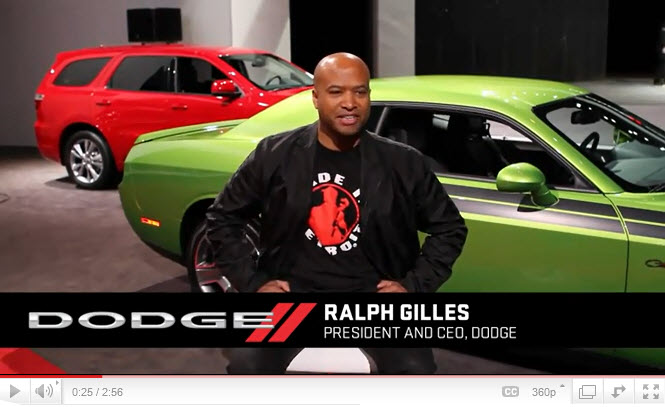
I’m not a car guy.  My sister knows more about engines than I do, not that there’s anything sexist in that statement (maybe there is.)  I asked my son recently “What’s a Hemi?”  That’s the context.  But I do know advertising and marketing and have an ear for what consumers will like. And the president and CEO of Dodge, Ralph Gilles, talking about his brand and the tres cool Dodge Challenger (in this video) is a winning piece of marketing.  Shot and (perhaps?) concepted by Cobrandit’s Owen Mack, this piece made me want to go trade in my Prius for a Dodge anything. Great advertising makes you feel something, then do something.  In my case the “do” was post to the blog.

Mr Gilles is the absolute perfect salesman for this car and this brand. Just listen to him.  Not a suit, he.  Just a lover of cars and engines and Dodge and, I can tell, people who love cars.  So they will trust him. He’s black, presumably from the motor city, rocking the bald head thing, styling the clothes.  He is very videogenic. And the cars he’s showing are pulsing with power.  As is he — in a very friendly way.

I worked at McCann for a number of years when they would trot out CEOs to walk through the corporate headquarters and tell America that “the road to the future was paved with GM” or some such.  It was suits selling suity cars. Wrong, wrong, wrong.

Mr. Gilles can bring back Dodge as long as the cars are good and he keeps talking to the people like this.  Get him on TV and radio.  Show these car designs, spin some Detroit magic, mint some money.  His next Job? The new US Fiats. Peace. 

 

Brand Identity…or Ornamentation?

0

Wikipedia defines a brand as an identity.  Many years ago, while excavating a late woodland Indian shell midden on Moshier Island for the University of Southern Maine, I came across a piece of deer rib bone I assumed was some type of weaving shuttle. (It wasn’t my day job.)  It had some notches on the bone which gave it a unique appearance and I wondered if they were ornamental or a personal identifier. 

Outside branding nerds, many in marketing today don’t quite know the difference between identifier brands and ornamental brands.   What’s the Idea? builds and rebuilds identifier brands.  Only then do we allow them to be ornamented.  And that dress up, as beautiful as it may be, must add to the identification story.  Go into a room, turn off the lights and listen to the voices of your friends and family. You can identify them.  But if you feel their clothes, not so much.

The big girls and boys know this.  Whenever an Interbrand, Landor or Wolff Olin starts a new  logo project they create a brief; one that sets the identity direction.  Recently for a commercial maintenance company I developed a strategy suggesting they were the  “Navy seals” of maintenance.  Preemptive, fast and fastidious.  When the art director went off to do logo designs, he had a directive. When the client reviewed designs, he knew “how to buy” and “what to approve.”  Of course some ornamentation got in the way and he wanted to be a “green” company and, and, and.  But the CEO ran his group with navy seal precision – it was the company. It was his identifier.   The mark and brand organizing principles where hard to debate.  This is how we do-oo it!.  Peace.

Music is Dying. And the Roots Backlash.

0

Here’s the problem with digital music.  It’s music.  And music consumption is being replaced by the internet and messaging. 

Daily book readership, as a percentage of leisure time spent, took a major hit when the radio came around. Radio listenership diminished with the advent of TV.  TV is fluctuating but as baby boomers go asunder it, too, will take a back seat to the growth of whatever is next.  Even today, if you look closely at ear buds they’re tethered to people staring at the screens (video) not to people with with eyes closed, boppin’ to music.

I don’t listen to much music anymore, unless I’m in a bar. Or when Pearl Jam or X come around.  I go to see Hot Tuna (Jorma and Jack) every year but friends orchestrate that.  A road trip to Williamsburg to see someone new like Justin Townes Earle is worthy, but I stumbled upon him by accident.  The radio really sucks.  Pandora is cool, perhaps the only thing that can save music, but the model is wrong. iTunes has sold 10 billion songs since 2003, but made negligible money (on the songs) doing so.  Music in the advertising  business used to be very important.  Now, most music on TV and radio ads is created by the algorithm.

The music business has been mismanaged and mislead. It will come back — but Lady Gaga at $.99 a song will not do it. And it will never be where it once was.  As art become replaced by engineering, we lose our humanity note by note. The roots backlash will help the arts but it could get ugly.   Peace.

It takes a blog.

0

Here’s the difference between the Daily Beast’s content strategy and that of AOL.  Daily.  AOL has a broad set of content properties with a new video focus and a top-tier Poster mentality, but the Daily Beast is all about today.  Combining of the Daily Beast and Newsweek was all about allowing the Beast to learn the journalism craft and investigative reporting and to infuse news gathering DNA into its being.  Whether or not the Beast subsumes and devours Newsweek, only time will tell (I suspect it will), but this is the play for the Beast.  It has set its sights on the Huff Post, part of the AOL family, and made an interesting move yesterday.

By bringing over the Daily Dish from The Atlantic yesterday (there’s that daily word again) and paying Andrew Sullivan for his column/post/blog, the Daily franchise will grow in stature and readers.  The brand is taking form.  In the magazine media form, first there were monthlies, then weeklies.  Online has allowed for dailies.  Of course newspapers are dailies and if anyone should own the daily label it should be them, but for some reason they can’t seem to get out of their own way.  It takes a blog.

Go ahead and laugh, but it won’t be long before someone comes along and takes the “hourly” franchise.  Peace. 


Brand Planning Patterns and Breakage.

0

In brand planning there are two schools of thought: Find the strength and highlight it, or find the weakness and negate it.  At the root of this approach is optimism vs. pessimism.  This is where quantitative research can play a role – testing which approach will have the biggest business impact.  But few mid and small-sized companies are willing to spend that money.  Large companies will, but tend not to want to do major brand planning overhauls unless under attack. Pessimism, then, often wins out.

Consumer Marketing

Consumer marketers by nature are all about the positive. All about the user benefit and that’s a good thing. But if everyone, in every consumer category, is being positive: “be more productive,” “more individualized service,” “lower cost” then it’s hard to make an impression. 

Business-to-business.

In B2B selling for the last 10 years, sales people trek annually to Arizona to chant “Find the pain point.” Understanding a company’s pain seems the pop marketing way for a B2B salesperson to connect in a meaningful way.  And therein lies a marketing conundrum: consumer marketing labors around the positive while B2B favors the negative. Overstatements perhaps, but patterns. And brand planning is about patterns and breaking or disrupting them; in ways that serve all consumers — with actionable, scalable and repeatable ideas that sell.  Watch the patterns. Peace.

  Brand planning, patternsm pan points, b2b marketing, consumer marketing, whatstheidea, whats the idea,

Brand Planning Tip. Hear the Energy.

0


Over the years I’ve found many words around which to probe when interviewing people to get to important, actionable branding insights.  “Pride” is one such word.  On the business side “tolerance” is another.  “What are some other things you are willing to tolerate if they help you make money.” For building a business plan, I have the 24 questions.  If going short form, a diff battery of questions to get at what’s what. 

But in all frankness, it’s not the forms; they are just a starting place — a brand planner has to have a good ear. And s/he turns that ear into a microphone that plays back what it hears into further probes…creating energy. If energy or heat is generated around an opportunity or an advantage, take that path because energy begets energy.  If the probee checks his or her mobile, abort and redirect.

As an anthropology student at Rollins College, I was once rebuked by a peer who thought as an ethnographer I needed to stay outside of the events observed. By insinuating myself into the situation I changed it, and he was quite right. But as a brand planner, people want to know you care about what they care about.  Then they open up.  I’m not talking about panelists talking about their itchy asses behind the glass, I’m talking about two people looking into one another eyes, and talking with personal energy and interest. Ask, listen, learn. Go off piste if it is where the interview goes. Probees can see your interest in your eyes. They can hear it in the timbre of your voice. If you are energized, they will deliver. Peace.

The Is-Does and Branding Fundies.

0

I came up with the branding Is-Does a while back because while operating in the technology sector I realized many start-ups don’t always know what their company “is.”  Oddly, it’s also true in some Fortune 500 companies. Case in point: the CEO of the world’s largest home care company for whom I did some consulting went around the room at an executive gathering asking each officer “What business do you think we’re in?” He was referring to the managed care part of the business, but it was still a billion dollar revenue stream. And the “is” is the easy stuff. The “does” is what gives people fits.

A chief technology officer at software company I worked for could not answer the “What the business does?” question in a half hour.   

The Is-Does is a wonderful brand planning starting point.  It’s not a mission, or a brand promise, elevator speech or brief. It answers the question what a brand “is” and what a brand “does.”  Keith Hernandez might call them fundies. 

I was invited into a meeting at an important non-profit.  I say important because it was a community center in a under-served neighborhood trying to save lives and build lives. The meeting had close to 25 people including a song writer, teachers, web-o-files, marketers, community advocates, nutritionists and more.  The facilitator (a branding dude) had a huge pad, a marker and as he was getting ready to lay down some marketing rhymes, you could tell he didn’t know exactly where to start.  So I suggested the Is-Does. And off we went. Peace!

Longer Employment Contracts?

0

The speed of the Internet is pretty amazing.  In an instant a great idea like, say, Carla Emil’s “One Job For America,” can go viral and change the world (let’s hope so).  Businesses such as Groupon can launch with a real monetization plan and become a billion dollar company. Businesses without a real monetization plan can launch (Twitter) and do the same.  Much of it is because of technology and the Inter-nech. 

But commerce in this world is still driven by people, IBM’s Watson aside. And people are often a company’s biggest asset.  If you leave a company they can wipe your hard drive but not your gray matter.  Something learned at company A can be re-envisioned at company B.  There is a lot of churn today in the corporate ranks and the freelance economy is also quite viable.  But I see a change in this churn behavior when I look beyond the dashboard. The Japanese used to talk about “employees for life.”  Well, even though this behavior seems unabashedly un-American, I see us moving in this direction. I expect to see at the top and mid-top levels of American companies employment contracts of much longer durations.  Just as a baseball team wants its #1 starting pitcher around for 7 years, smart companies moving at internet speed need their key difference- makers to stick around.  Had Ray Ozzie signed a 25 year contract, would that have made a difference? How about Tim Armstrong?  

Movement from company to company can be a healthy thing for top executives, but staying and working within the system makes the system stronger.  This I see. Peace!

CBS. FOX and Yahoo!

0

CBS is a content company. Most think of it as a TV channel…with a bit of an integration problem across the country.  Different call letters, different channel numbers, not where it’s supposed to be on the dial when you move from city to city.  (See? Platform integration has always been around, it’s not just an issue for the TechCrunch crowd.)  CBS has always been dinged for catering to the older market. Well, in today’s media world the older market watches TV. Lots of it. And CBS’s quarterly numbers are quite strong, especially for local sales.   CBS owns C|Net and ZDNet, which along with other web properties, is helping the company diversify and learn about new targets, markets and categories.  CBS has radio, outdoor, book publishing, and other web properties in addition to cable and broadcast, which positions it nicely as all media moves towards the middle.  At its very core, CBS is a content play.

And in a new media world where everyone’s a publisher therefore no one’s a publish, CBS continues to crank out content people want to watch, hear, and read.  This content strategy is also the strategy of AOL and Yahoo!.  Oddly, they are all competitors.  I know AOL and Time Warner didn’t make it, but that was then.  WABC (Disney) and WNBC (Comcast) have too much baggage.  Fox has the stomach for it (read MySpace), so I predict Yahoo!, or less likely AOL, will be purchased by Mr. Murdoch and FOX.  This would be the year to do it, too.   Peace!

Brand Design vs. Product Design.

0

Which comes first?  It’s not a trick question.  And I won’t go all “sort of” on you.  The answer is product design.  A good brand planner will take the product design, understand it and package it.  A great brand planner, while packaging the product will “inform” it — change, evolve, aspire it and help create its future.

Brand planners know when you see a friend’s baby for the first time there’s a difference between “What a beautiful baby” and “Ooh, what an amazing rosebud mouth.”  It’s the different between talking an observing. Most marketing today is talk. When you talk to a product designer and really see what they have created, you connect.  Just like when you really see someone’s baby.

In today’s commodities world (see yesterday’s post on banks and healthcare), it is imperative for planners to find the difference.  It may only be a DNA-like strand, but it’s there. And once found that difference can give form to the brand idea.  Not a tagline, not a campaign, but a brand idea: The world’s information in one click. Refreshment.  Different.  The people who tell you brand design comes first are probably art directors. Or peddlers of marko-babble.  Peace be with you and with Lara Logan and her family.