Greed in marketing. Something to tink about.

0

Greed in marketing is nothing new.  Being different. Acting different. Selling differently…all support creating a competitive advantage and making more money. But greed is not a good thing.  It has ruined the economy (mortgage-backed securities), kept the U.S. beholden to terrorist oil states, and no doubt played a role in many hatreds around the world.  Sometimes greed needs to reach a breaking point before it succumbs.

Yesterday’s announcement between Ford and Toyota, to work on a hybrid engine for pick-up trucks may be a good sign for the planet and for marketing. The U.S. gov’t smartly threw down the gauntlet in terms of miles per gallon goals for vehicles recently and this new rear wheel drive engine is a massive step toward meeting those goals. (Anyone home GM?) Normally, greed would have kept a deal like this from happening, but Ford and Toyota are showing good judgment and forward thinking and they woman-ed up.  Oh, and the only reason it is happening is because Alan R. Mulally and  Akio Toyoda (company CEOs) ran into each other in the airport and probably actually liked one another.

As we marketers put our plans together, fill in our charts and goals and KPIs, how about we ask ourselves a simple tough question “If I wasn’t going to be greedy, what new company strategy might I employ?” As my Norwegian aunt might have said “Tink about it.”  Peace!  

The Digital Triangle. The Perfect Start-up Womb.

0

The digital triangle, located in NYC, bears three distinct corners.  DUMBO in Brooklyn. SOHO in Manhattan. Union Square, also in Manhattan.

DUMBO is where the coders are.  A youthful tech workforce who live digitally-centric lives, they are smart and have engineer-friendly minds. (A lot of gamer consoles burn out in DUMBO.) It’s a little men and boy heavy.  Union Square is where the money is.  Where the incubators are.  It’s where the DUMBO denizens with entrepreneurial spirit visit with their hands out.  It’s close to NYU and also has a lovely, youthful energy. Parking is expensive in Union Square but the smart money walks the streets.  SOHO is what makes the digital triangle different.  It is where designers, the truly creative and exceptionally beautiful like to call home. They don’t live there really, just work, shop and hang. If you can’t get inspired in SOHO with all its art, nubes, soft tacos, fashion, and vibe, you can’t get inspired.  All these neighborhoods are a subway or bike ride apart and feed off of each other. It is a perfect storm for start-ups.  

Unlike Sand Hill Road (money), its surrounding neighborhoods of Menlo Park, Palo Alto, etc. (tech engineers) and San Francisco (ad people) the Digital Triangle is close but not really connected. The west coast likes campuses. It works but not like the digital triangle. As technology’s pull increases and more and more of the economy is tied to digital commerce, NYC will grow in importance globally and will become a tech capital with no peer. Just ask Fred Wilson. Peace.

Bi-Polar Disorder at HP?

0

Leo Apotheker CEO of HP in a recent interview came off as a really smart, refreshingly calm captain of the tech industry.  You know the type, not smiling but almost, methodical and thoughtful in his delivery. Confident, not cocky. He knew his numbers, his trends, margins (everyone’s margins, in fact) and had a plan – a future-proof plan.  Use WebOs as the connective tissue for all computing and communication devices, bolstered by an enterprise cloud play.  Lovely.  Sprawling but lovely. Anyone smell an apple?

Those who read these musings know I am all about focus.  That’s the brand planner in me. HP has been anything but focused over the last 10 years. A printer company. The world’s leading PC company. Outsourcing. Big iron. Smart phones. Tabs. And operating systems. But let’s not forget in the post Carly Fiorina era, this company’s financials have been smoking. So the company’s scale has been a positive.

In a stunning announcement yesterday, Mr. Apotheker went on record as saying he wants to jettison tablets, smart phones and the WebOs as businesses, sell the PC business as a standalone unit and buy Autonomy Software for $10B. Normally, I would support this type of move, especially for a floundering company, but this almost feels other-worldly.

The reported for the New York Times Verne G. Kopytoff (also sounds fishy) used words to describe the PC move such as “dump” and “unload.” What PR person was handling this briefing?   

I understand the need for focus and I get the desire to increase margins through upping the software and cloud quotient, which by the way dials down the need for headcount, but this business move feels bi-polar. I wonder how the story is playing in the HP Personal Systems Group today?  Check the meds. Peace.


The Most Powerful Word in Brand Planning.

0

If allowed only one question with a consumer during a brand planning interview I would use that question to delve into “pride.”  In my years doing strategic work I’ve found it to be the most personal of questions. And the answers are always pregnant…and telling.

Planners can dig into anger, happiness, product usage stories, displeasure with competitive offerings, and a cocktail of other consumer probes – all of which are valuable, but pride, be it individual, societal or cultural often cuts to the chase.

If doing strategic planning for a business, marketing probes typically end up in the land of margins and revenue and sales, but asked about pride and the color of the answers change. Pride is soul stuff.  Pride gets you into emotional territory.  Though it can be touchy,  a little personal and may require careful handling, it is very fertile ground and almost always provides powerful brand insights.

Now go forth lions and find your pride. Peace.


A note to Sherwin-Williams.

0

One of the fun things about being a marketing consultant is helping companies come up with new products.  Today most call this practice innovation.  I have a new R&D idea for Sherwin-Williams or really any paint manufacturer.  Design a clear coat finish for external house paint that when spayed on in a light mist will add years to the life of the product, improve color retention and prevent mold.   I’m no scientist, but one would think a breathable (or not) resin applied over a new coat of paint that helped extend the life of the finish would be something most home owners would invest in. Especially if priced correctly. 

The product would add to the total ticket price of the average house paint sale. Sherwin-Williams could even sell or rent the spray machine for an added revenue opportunity.  And as a new product category, this sealer/finisher would grow the total market.  “Add 5 years to the life of your paint job for only $99.”

I love growing markets and categories.  Now, if I could only just get a hair color company to make it cool for men to color their hair…

Are there ways to repackage and add to your product offering?  Give it some thought. Peace.

Google’s All You Can Eat Strategy.

0

Google’s “culture of technological obesity” reared its really big head yesterday and the company in early 2012 will be getting into the hardware business — following its intention announced yesterday to buy Motorola Mobility.  We’re not talking a nail salon breaking out pumice stones and getting into the foot care business, were talking about a software company buying manufacturing plants, accountants to manage depreciation, thousands of other-continent employees, and then playing the materials engineering,  just-in-time game.  No Beta release here.  No limited invites here.  (I don’t know how Apple does it, frankly.)

This is one bold, bold move. And there’s no reason it shouldn’t work.  There are hundreds of reasons it shouldn’t work, but no one reason.  The justice department had better staff up me droogies.

Unless someone comes along and proves that mobile computing causes brain or pituitary cancer, mobile computing is here to stay and with one company owning the OS, device, search and funding (advertising), it feels like quite the monopoly.  And don’t think Larry Page doesn’t have his eye on Sprint or Metro PCS. Google can eat. And eat. And think. And plan. And spend. This is going to be one wild planet-changing ride! If there was a global, publically traded law firm, I’d say buy stock today. Peace!

Google, One Step Closer to Trivestiture

0

In February of last year I predicted Google would split into 3 companies.  With its intent to purchase Motorola Mobility, announced this morning, Google is one step closer.  The point of my original prediction post was lost in favor of a searchable sound bite reposted by Steve Rubel: “Google’s culture of technological obesity” but that trivestiture angle may now take on some weight.

This is a very big move for Google and will continue to blur the lines between hard and soft ware companies no doubt with an expected response from “Guess who?” Microsoft. (Look for a potential full purchase of Nokia within the year.) Mobile is so hinky and malleable right now I think the Android/Moto thing will work. And then open may be out the door — guess we’ll see.

For all the tech prognosticators this announcement will create some serious buzz and take eyes off of Google+, a half-baked though still tasty cake.

Como se wow!  September should be an interesting month. Peace! 

Claim and Proof in Brand Planning.

0

I’m reading the book Disruption by Jean-Marie Dru — it’s about time, I know – which was a pretty famous advertising thought piece back in the 90s. Even creative directors referred to it and they’re not ones to readily admit being inspired by other CDs. Live ones that is.

And Mr. Dru talks about two elements of an ad: the idea and the execution. The idea is the demonstration of the product value and the execution is the creative surround. So for Charmin bath tissue, said Mr. Dru, the idea was “squeezably soft” and Mr. Whipple was the execution.  

Brand planning for me follows this route for the most part, though I use words “claim” and “proof.”  The claim is the “idea” and the proof is the “execution.”  But in my world the execution is very organized.  Organized by selling schema in the form of three brand planks.  For a commercial maintenance company I wrote a brand brief that likened the company to the Navy Seals of maintenance. The planks were Preemptive, Fast and Fastidious.  When the client presented the company online, in brochure, ad or in person, the presentation was always cloaked in one of these three principles.  The company prevents problems through forethought, is absolutely quick to react, and precise and fastidious about every job.  Like a Navy Seal. This is a coda employees need to live by and one that customers find easy to grasp and hold on to. 

In branding, Claim and proof, well thought out, works every time.  That’s disruption! Peace!

AOL Not Yet Filling the Void.

0

There is strategy and there is execution.  A great strategy poorly executed pays naught. I like AOL’s “content is king” strategy; buying the Huffington Post and TechCrunch were nice blockbuster moves.  There are two ways for these purchases to go: either the properties will be enhanced by AOL and grow or they’ll be hindered and slide.  At the high end, these two purchases are defining moments and should be very interesting to follow.

But let’s look at the lower or middle tier. AOL now needs to find some traffic-building Posters (original content creators) on their way up.  Not those owning killer numbers, but those with killer points of view and motivations with big upside.  Sports teams make a living off of young over-performers who are killing it before their first big contract. Up and comers are what AOL needs. Some of whom may not even be Posters yet.   

Finding potential big time Posters is R&D in the web content world.  AOL needs to research what people like online, then find and/or develop the property.  Content is not writing. It’s not reporting.  It’s not curating or aggregating. These are content tactics.  The best Posters (who attract the all-important Pasters) are people with an idea, a passion, a motivation or a love. They are also sharers.  AOL is buying media properties and traffic and that’s a good start, albeit a bit old school.  It now needs to do some R&D and find ideas that fill voids. In markets and brains.  Peace!

Feets Don’t Fail Under Armour Now.

0

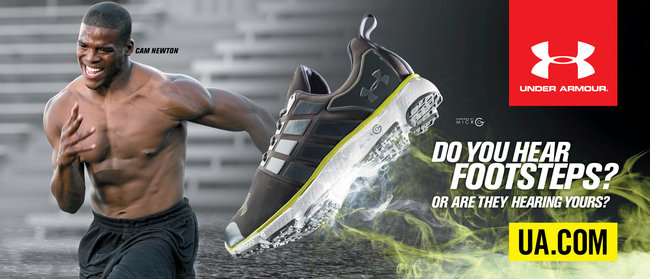
Under Armour is introducing two new sneaker designs (May I call them sneakers?) this week in an attempt to increase its share of the $22B athletic footwear (sneakers) market.  A market, by the way, that was only about $3B in 1993.  The TV campaign handled by Twofifteen McCann and Digiteria for digital offers a lot of smart tactics: the director of Friday Night Lights, a YouTube takeover to reach the younger buyers, limited distribution to build demand, Cam Newton, and an idea that ties sneakers to sports action – Footsteps.  As smart as these tactics are, they feel like a pastiche of forced-together marketing tools from an Effie Awards Annual. I suspect they will work, however.

First and foremost though, one must ask if footwear is a business Under Armour wants to be in.  I say no. And I’ve said so before in WTI.  Sunglasses? No as well. UA founder Kevin Plank, in his heart knows this.  He owns a franchise that is now being diluting.  You can’t keep sticking the same tea bag in new water.  The company already owns fast twitch muscle, form fitting wicking shirts but will lose that ownership as it takes its eyes off the ball. Wicking sneaker tops?  Not so sexy.  Lindsey Vonn. Oh yeah.

Mr. Plank’s next move should be into form fitting shorts and shirts for the fashion conscious market.  Leave the kicks to Nike.  Or start a new footwear endemic company  This is one brand extension that might sell some shoes near term, but is going to turn Under Armour into a brand in decline overall.  And it’s sad.  Stop playing with feet! Peace.

(Picture from NY Times.)